Quantum Adversarial Machine Learning
Paper Information
Title: Quantum Adversarial Machine Learning
Authors: Sirui Lu, Lu-Ming Duan, Dong-Ling Deng
Published: Physical Review Research, 2, 033212 (2020)
DOI: 10.1103/PhysRevResearch.2.033212
Reproduction Status: Complete
Reproducer: Benjamin Stott (benjamin.stott@quandela.com)
Project Repository
Abstract
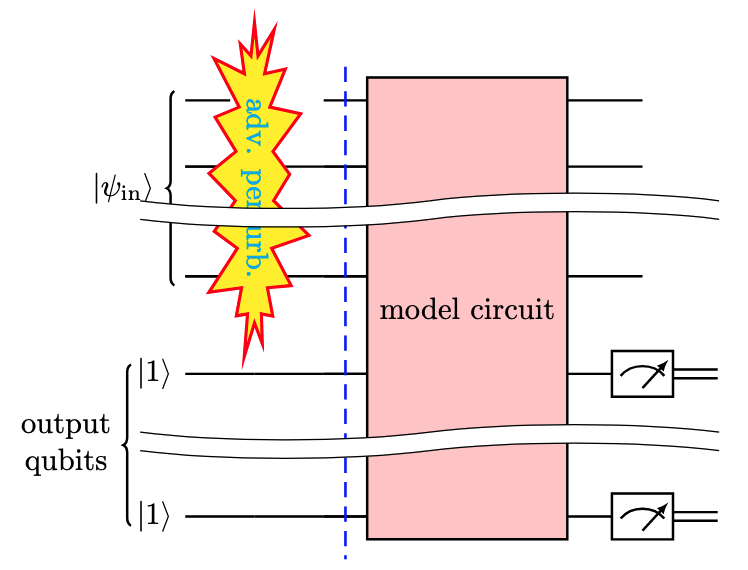
This paper investigates whether quantum machine learning models are vulnerable to adversarial attacks - imperceptible perturbations that cause misclassification - in a way analogous to classical neural networks. Lu et al. demonstrate that hybrid classical-quantum classifiers are susceptible to standard gradient-based attacks (FGSM, BIM, PGD, MIM) regardless of whether the input is classical image data or quantum ground-state data.
A key finding is that adversarial perturbations are qualitatively different from random noise: at the same perturbation magnitude, adversarial attacks can reduce accuracy to near zero while random noise leaves accuracy almost unchanged. The paper also shows that adversarial examples crafted against classical surrogates transfer to quantum classifiers, and that adversarial training can substantially recover robustness.
Significance
This paper is one of the first systematic studies of adversarial robustness in quantum machine learning. It establishes that adversarial vulnerability is not a property of the classical computing paradigm - it carries over to quantum classifiers. This has direct implications for any near-term application of quantum ML in security-sensitive domains. The work also introduces functional attacks, where perturbations are applied as local unitary operations, which is the natural attack model for quantum-native inputs such as ground states of physical systems.
MerLin Implementation
MerLin is used to construct photonic quantum classifiers based on beam splitter meshes and
phase shifters. The QuantumLayer performs amplitude encoding: classical input vectors are
mapped to Fock basis state amplitudes, so a 256-pixel MNIST image is encoded into a
superposition over the 286 Fock states of a 13-mode, 3-photon circuit. The beam splitters
have fixed angles; the trainable parameters are the phase shifters, which are optimised via
standard PyTorch gradient descent. Adversarial gradients are back-propagated through the
quantum layer in the same way.
Key Contributions
Demonstration that quantum classifiers are vulnerable to adversarial attacks
We have trained a photonic quantum classifier on binary MNIST (digits 1 vs 9) achieving 99.6% clean accuracy. We then showed that a BIM attack at perturbation magnitude ε = 0.1 reduces accuracy from 99.6% to 0.0%, faithfully reproducing the paper’s central finding.
We have also reproduced the key contrast between adversarial and random noise: at ε = 0.1, adversarial accuracy collapses to 0.0% while uniform random noise of the same magnitude leaves accuracy at 99.2%, and photon loss noise reduces it by less than 0.3 percentage points.
Adversarial attack suite
We have implemented FGSM, BIM, PGD, and MIM attacks as differentiable PyTorch operations compatible with the MerLin photonic backend. We have also implemented functional attacks using local phase shifter perturbations, the photonic-native analogue of the unitary perturbations described in the paper for quantum-native inputs.
Adversarial training defense
We have reproduced the adversarial training defense using a smaller model (8 modes, 2 photons). After adversarial training with BIM at epsilon = 0.1, clean accuracy is maintained at 100% and adversarial accuracy recovers to 42%, compared to 0% for the undefended model. Adversarial training with the larger model (13 modes, 3 photons) is more sensitive to hyperparameter choices and requires more epochs to converge under adversarial training pressure.
Implementation Details
The photonic quantum classifier uses amplitude encoding where classical data is normalised to unit L2 norm and mapped directly to Fock basis state amplitudes. For MNIST, 13 modes and 3 photons give C(13,3) = 286 Fock states, sufficient to encode 256-pixel images without any classical compression.
from lib.circuits import MerLinAmplitudeClassifier
from lib.models import create_model

model = create_model({
    "type": "amplitude_quantum",
    "input_dim": 256,           # 16×16 pixels
    "n_outputs": 2,             # Binary classification
    "n_modes": 13,              # C(13,3) = 286 ≥ 256
    "n_photons": 3,
    "n_layers": 2,
    "computation_space": "unbunched",
})

# Adversarial examples via back-propagation through the quantum layer
from lib.attacks import bim_attack

adv_images = bim_attack(
    model, images, labels,
    epsilon=0.1, alpha=0.01, num_iter=10,
)

# Adversarial training
from lib.defense import adversarial_training

robust_model = adversarial_training(
    model, train_loader, attack_method="bim", epsilon=0.1, epochs=100,
)
Extensions and Future Work
Enhanced Capabilities
A PennyLane gate-based backend is included alongside MerLin, implementing the original paper’s architecture (Z-X-Z Euler rotations and a CNOT ladder), allowing direct comparison of adversarial vulnerability across photonic and qubit-based quantum classifiers.
Photon loss is added as a physically motivated noise model using Perceval’s
NoiseModel.
Experimental Extensions
An amplitude vs angle encoding robustness comparison reveals that the classical compression bottleneck in angle encoding provides a degree of adversarial robustness as a by-product, with angle encoding reaching 41.8% accuracy at ε = 0.05 compared to 2.2% for direct amplitude encoding.
The
encoding_comparison.shscript benchmarks three encoding strategies (direct amplitude, compressed amplitude, and angle) systematically across multiple ε values.
Hardware Considerations
All experiments can be run on CPU. Smoke-test configs run in under 30 seconds.
Full adversarial training approximately doubles wall-clock training time and is best run via the provided shell scripts.
Future Work
A systematic evaluation across black-box, gray-box, and white-box threat models would give a more complete picture of quantum classifier vulnerability than the white-box attacks reproduced here.
Studying adversarial robustness across multiple circuit depths and the two encoding schemes together would clarify the capacity-robustness trade-off suggested by our amplitude vs angle encoding comparison.
Citation
@article{lu2020quantum,
  title={Quantum adversarial machine learning},
  author={Lu, Sirui and Duan, Lu-Ming and Deng, Dong-Ling},
  journal={Physical Review Research},
  volume={2},
  number={3},
  pages={033212},
  year={2020},
  publisher={APS},
  doi={10.1103/PhysRevResearch.2.033212}
}