Photonic Quantum Generative Adversarial Networks for Classical Data
Paper Information
Title: Photonic quantum generative adversarial networks for classical data
Authors: Tigran Sedrakyan and Alexia Salavrakos
Published: Optica Quantum, vol. 2, no. 6, pp. 458-467 (2025)
DOI: 10.1364/OPTICAQ.530346 Paper URL: arXiv:2405.06023
Reproduction Status: 🚧 In Progress (MerLin QuantumLayer generator implemented; extended benchmarking and write-up ongoing)
Reproducer: Alexia Salavrakos & Cassandre Notton (cassandre.notton@quandela.com)
Project Repository
Abstract
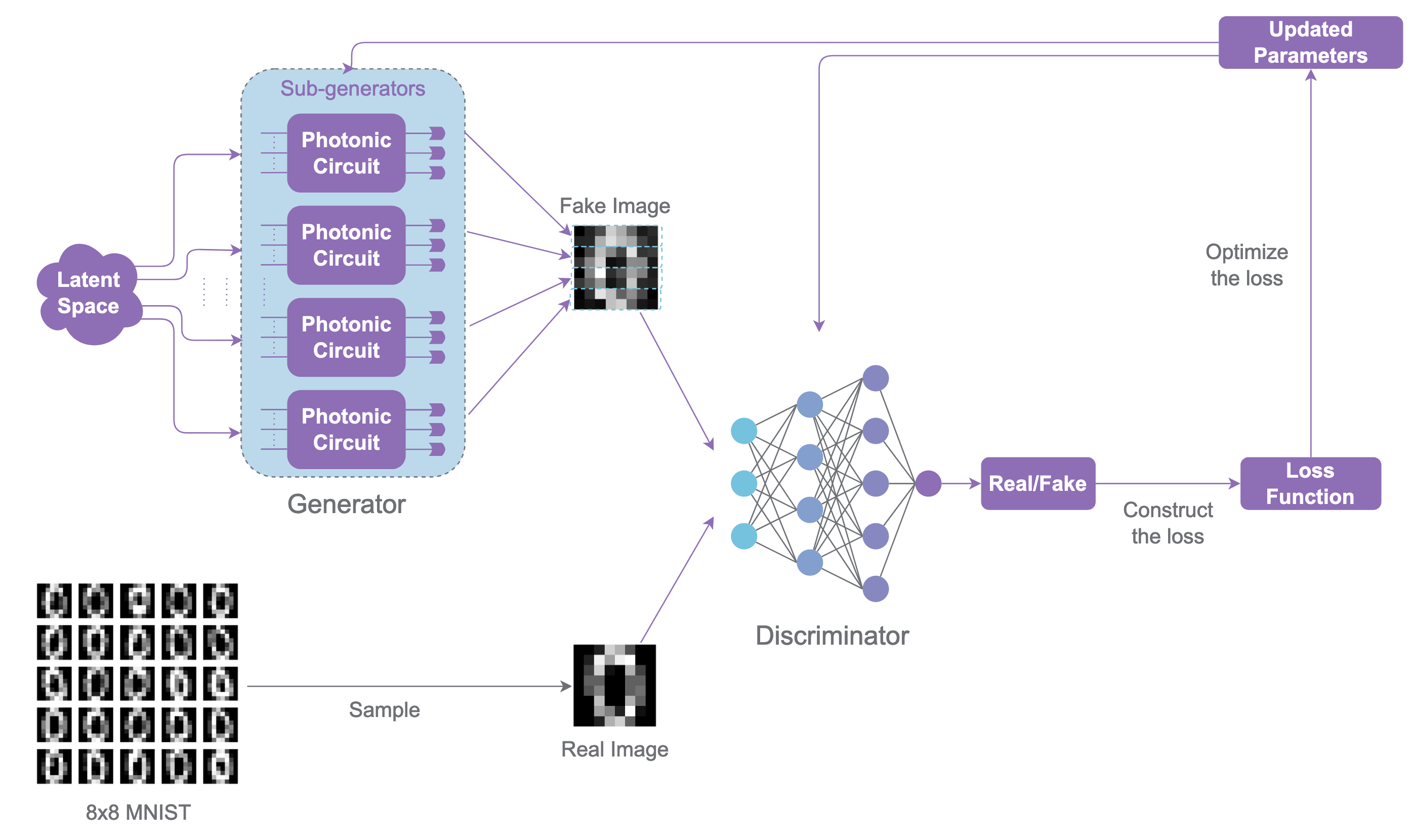
This work introduces a photonic QGAN that learns classical image distributions with linear optical circuits in Fock-space encoding. The adversarial setup follows the classical GAN game: a generator synthesizes samples while a discriminator learns to separate real and generated data.
Unlike qubit-only QGAN proposals, the paper targets a near-term photonic path by using interferometers, photon-number states, and measurement-based readout. The reported experiments show end-to-end learning of image data, including hardware-compatible settings on a single-photon platform.
Significance
The paper closes an implementation gap between GAN theory and practical photonic hardware constraints. It demonstrates that adversarial training can be done with linear optics and Fock measurements, without requiring fault-tolerant gate-model devices.
For MerLin users, this is a strong benchmark problem because it combines:
variational photonic circuits,
data encoding in circuit parameters,
stochastic measurement outputs,
and a hybrid optimization loop (quantum generator plus classical discriminator).
MerLin Implementation
The current reproduced implementation (in merlinquantum/reproduced_papers) uses a MerLin-native photonic generator path. PatchGenerator is implemented as a torch.nn.Module and internally instantiates one ML.QuantumLayer per patch.
The adversarial loop in lib/qgan.py is fully differentiable:
discriminator and generator are optimized with Adam,
BCE-with-logits loss is used for both adversaries,
optional label smoothing and configurable
d_steps/g_stepsare supported.
At this stage:
smokemode is a lightweight wiring check,digitsandidealtrain the MerLinQuantumLayergenerator end-to-end,hp_studyperforms successive-halving hyperparameter search on Adam-based training,PatchGeneratorLegacyremains available as a reference for the previous sampler/SPSA workflow.
Key Contributions Reproduced
- Project Packaging and Execution
Reproduction code is modularized into generator/discriminator/model/runner components.
Config-driven execution is available through
configs/defaults.json.digitsandidealworkflows are scriptable fromimplementation.py.
- MerLin QuantumLayer Generator
Patch-wise image generation is implemented with a
ModuleListofML.QuantumLayerobjects.Each patch layer is built from
ParametrizedQuantumCircuitand receives latent features through named encoding parameters.Fock-basis probabilities are regrouped and mapped into patch pixels, then concatenated into full images.
- Differentiable GAN Training
Generator and discriminator are both trained with Adam in PyTorch.
Training supports configurable update ratios (
d_steps,g_steps) and smoothed labels.SSIM-based similarity/diversity metrics are computed during runs.
Implementation Details
The implemented PatchGenerator in lib/generators.py builds gen_count independent quantum layers and treats each as a patch generator. For a latent minibatch z:
# 1) Evaluate each patch quantum layer
raw_results_list = [m(z) for m in self.models]

# 2) Regroup measurement probabilities with output_map
gen_out = torch.zeros((B, self.bin_count), device=device, dtype=dtype)
gen_out.index_add_(1, idx, res)

# 3) Normalize and resize each patch to expected pixel count
gen_out = gen_out / (total_count + 1e-8)
img_gen = gen_out[:, surplus_half:surplus_half + expected_len]  # or zero-pad

# 4) Concatenate patch tensors into one image vector
return torch.cat(patches, dim=1)
PatchGeneratorLegacy remains in the same file as a reference implementation of the previous Perceval sampler path.
Experimental Results
The repository now provides MerLin-based training modes and artifacts, with ongoing work focused on broad benchmark coverage and final reporting.
Mode |
Status |
Notes |
|---|---|---|
|
✅ Available |
Fast pipeline validation; writes a completion marker. |
|
✅ Available (MerLin) |
Optdigits subset training with the |
|
✅ Available (MerLin) |
Grid sweep over architecture/input-state configurations with differentiable training. |
|
✅ Available |
Successive-halving hyperparameter search for Adam training parameters. |
MerLin |
✅ Implemented |
Active in |
Note
Result plots and generated samples are currently documented in the reproduced-papers project notebooks and output CSV artifacts.
How QuantumLayer Fits This Reproduction
Current behavior in PatchGenerator
PatchGenerator currently owns:
a
ModuleListofML.QuantumLayerblocks (one per patch),named input parameter binding from latent noise to circuit encoding parameters,
trainable variational circuit parameters exposed as PyTorch parameters,
tensor-native post-processing from output probabilities to image patches.
Gradients now propagate through the quantum generator, so the GAN loop can use standard PyTorch optimizers.
Implemented QuantumLayer pattern
The active implementation in lib/generators.py follows this structure:
import merlin as ml
import torch
import torch.nn as nn

class PatchGeneratorMerlin(nn.Module):
    def __init__(self, gen_count, gen_arch, input_state):
        super().__init__()
        self.layers = nn.ModuleList()
        for _ in range(gen_count):
            pcvl_circuit = ParametrizedQuantumCircuit(len(input_state), gen_arch)
            layer = ml.QuantumLayer(
                input_size=len(pcvl_circuit.enc_param_names),
                circuit=pcvl_circuit.circuit,
                input_parameters=pcvl_circuit.enc_param_names,
                trainable_parameters=pcvl_circuit.var_param_names,
                input_state=input_state,
                measurement_strategy=ml.MeasurementStrategy.PROBABILITIES,
                computation_space=ml.ComputationSpace.FOCK,
            )
            self.layers.append(layer)

    def forward(self, z):
        patch_probs = [layer(z) for layer in self.layers]
        return torch.cat(patch_probs, dim=-1)
The file also keeps PatchGeneratorLegacy for backward comparison with the older sampler-based implementation.
With this implementation:
variational parameters become standard trainable PyTorch parameters,
generator updates use
torch.optim(Adam inlib/qgan.py),the default training loop no longer depends on SPSA.
Interactive Exploration
Notebook status in this docs repository: dedicated photonic_QGAN notebook page is not yet published under docs/source/notebooks/reproduced_papers.
Available notebooks in reproduced-papers project:
notebooks/qgan_digits.ipynbnotebooks/qgan_ideal.ipynbnotebooks/qgan_noisy.ipynbnotebooks/classical_gan.ipynbnotebooks/analyse.ipynb
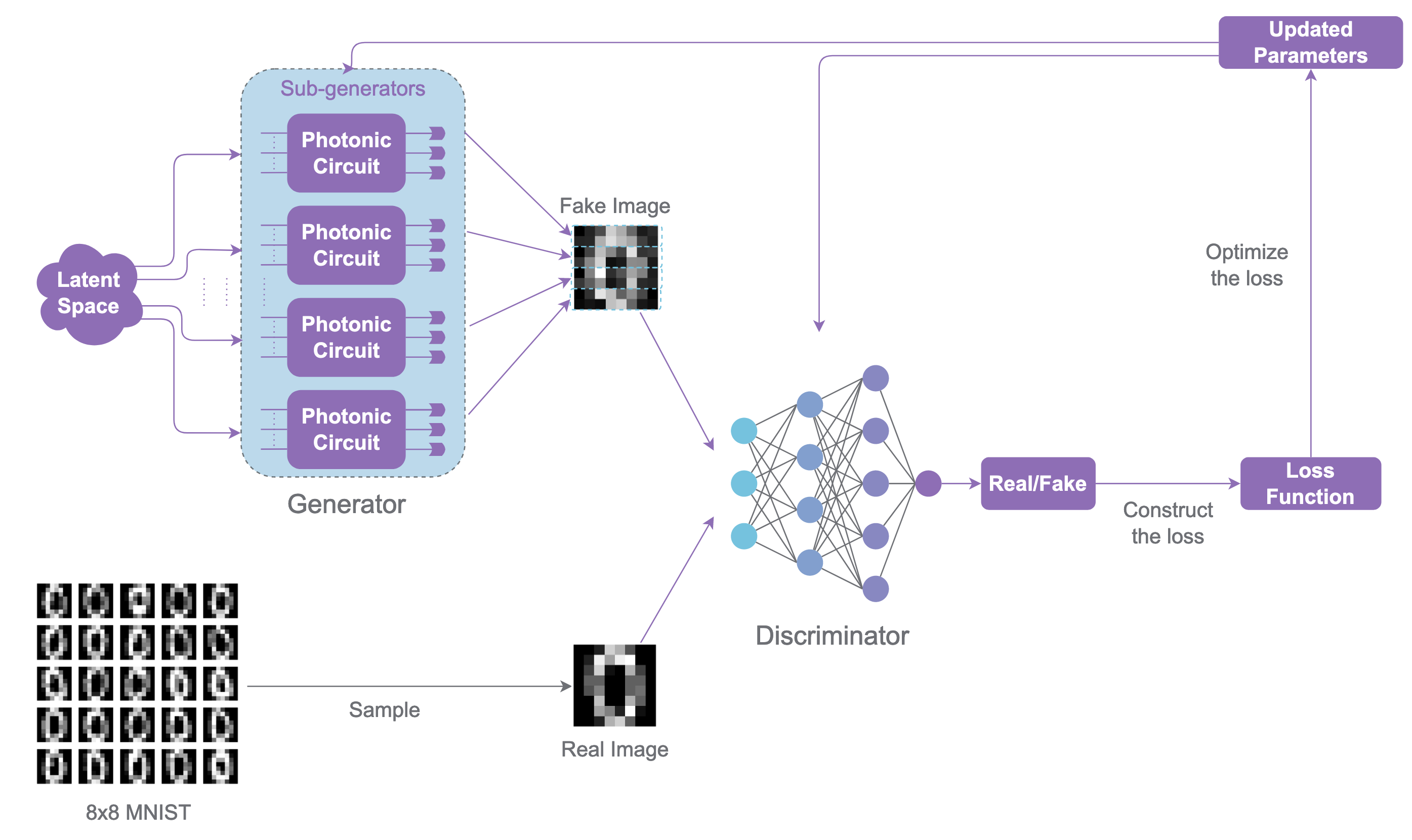
Photonic QGAN overview figure.
Extensions and Future Work
The key MerLin-native generator path is now implemented. The next work items focus on validation and cleanup.
- Planned migration steps
Finalize benchmark tables for
digits,ideal, andhp_studyin docs.Update deprecated measurement API usage to
MeasurementStrategy.probs(...)style.Decide long-term status of
PatchGeneratorLegacy(keep optional backend or deprecate).Consolidate notebook narratives around the MerLin default path.
Code Access and Documentation
Reproduction Repository: merlinquantum/reproduced_papers (photonic_QGAN)
Original Paper Repository: Quandela/photonic-qgan
For command-line usage and mode details, see the project README: photonic_QGAN README.
Citation
@article{sedrakyan2025photonicqgan,
  title={Photonic quantum generative adversarial networks for classical data},
  author={Sedrakyan, Tigran and Salavrakos, Alexia},
  journal={Optica Quantum},
  volume={2},
  number={6},
  pages={458--467},
  year={2025},
  doi={10.1364/OPTICAQ.530346}
}