Quantum Self-Supervised Learning (QSSL)
Paper Information
Title: Quantum Self-Supervised Learning
Authors: B. Jaderberg, L. W. Anderson, W. Xie, S. Albanie, M. Kiffner, D. Jaksch
Published: Quantum Science and Technology, Volume 7, Number 3 (2022)
Paper URL: arXiv:2103.14653
Reproduction Status: ✅ Complete
Reproducer: Cassandre Notton (cassandre.notton@quandela.com)
Project Repository
Abstract
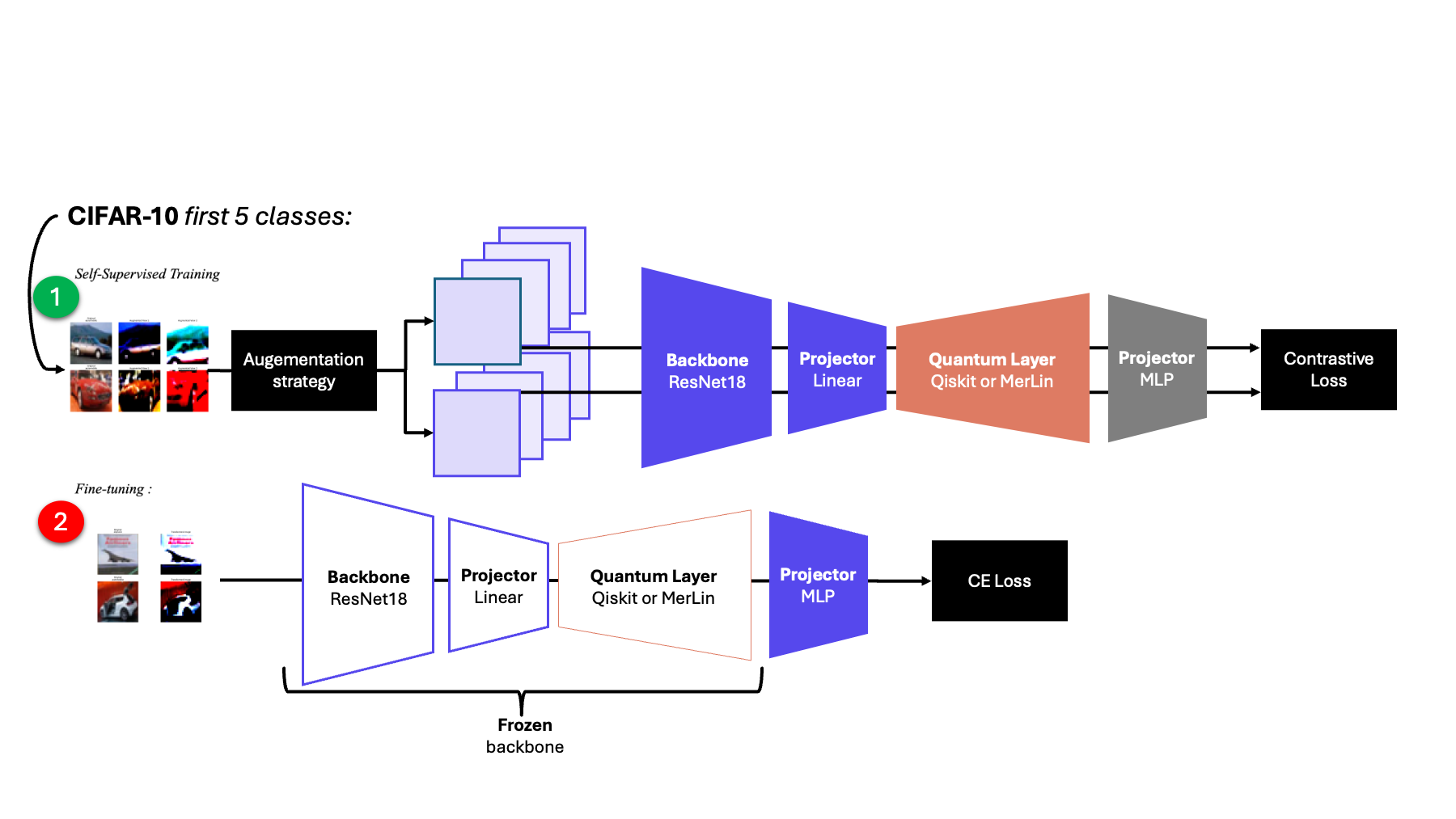
This reproduction studies the qSSL framework proposed by Jaderberg et al., where a quantum representation layer is trained inside a self-supervised SimCLR-style pipeline. The model uses two augmented views, InfoNCE contrastive loss, and linear evaluation on frozen representations.
The MerLin reproduction keeps the same high-level design and compares three representation backends under a shared training loop: Qiskit gate-model QNN, MerLin/Perceval photonic QNN, and a classical MLP baseline.
Significance
The original paper highlights self-supervised learning as a promising regime for practical quantum advantage because of the representational capacity required by SSL objectives. This reproduction validates that claim in the MerLin ecosystem and extends it with a photonic implementation that is competitive or better than the compared baselines in short-training settings.
MerLin Implementation
The implementation follows the standard qSSL recipe:
ResNet18 encoder (non-pretrained)
Linear compression from 512 features to
widthRepresentation block selected among
merlin,qiskit, andclassical2-layer projection head with BatchNorm
InfoNCE training on two augmented views, followed by frozen-encoder linear probing
How QuantumLayer is used (MerLin backend)
In papers/qSSL/lib/model.py, QuantumLayer is used as the MerLin
representation_network:
# __init__: build the MerLin representation block
self.circuit = create_quantum_circuit(modes=self.modes, feature_size=self.width)
input_state = [(i + 1) % 2 for i in range(args.modes)]

self.representation_network = QuantumLayer(
    input_size=self.width,
    circuit=self.circuit,
    trainable_parameters=[
        p.name for p in self.circuit.get_parameters()
        if not p.name.startswith("feature")
    ],
    input_parameters=["feature"],
    input_state=input_state,
    computation_space=ComputationSpace.UNBUNCHED,
    measurement_strategy=MeasurementStrategy.PROBABILITIES,
)

# forward: encoder -> quantum layer -> projection head
x1 = self.comp(self.backbone(y1))
x1 = torch.sigmoid(x1) * (1 / torch.pi)  # MerLin scaling
z1 = self.representation_network(x1)
z1 = self.proj(z1)
Minimal reading of this flow:
feature-*circuit parameters receive the compressed image features.Non-
featureparameters are trainable variational parameters.QuantumLayeroutput (probability features) is the representation used by InfoNCE after the projection head.
Default training settings used in reproduction runs:
Batch size: 256
Optimizer: Adam (
betas=(0.9, 0.999),lr=1e-3,weight_decay=1e-5)Temperature:
tau=0.07
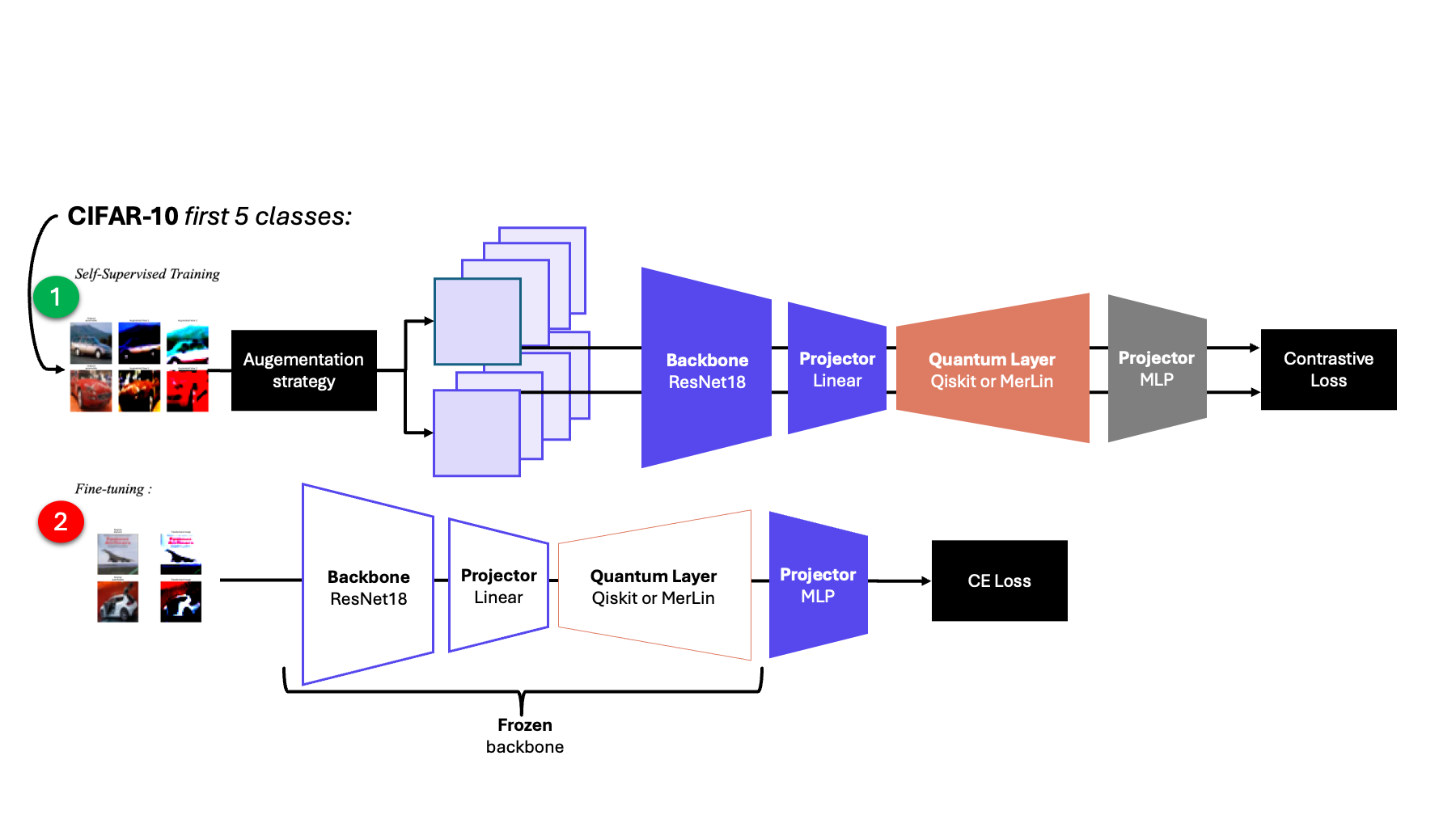
qSSL architecture used in the reproduction (shared encoder + selectable representation network + projection head).
Key Contributions Reproduced
- Unified backend comparison
Reproduced qSSL with Qiskit, MerLin photonic, and classical representations under the same training/evaluation stack.
Preserved the CIFAR-10 restricted-label setup used in the original work.
- Photonic qSSL implementation
Replaced the gate-model quantum layer with a photonic interferometer implementation in MerLin.
Evaluated multiple mode counts and both
no_bunchingsettings.
- End-to-end reproducibility
Produced SSL losses, linear-probe accuracies, checkpoints, and summary metrics for each run.
Added pretrained checkpoint support and linear-probing utilities.
Experimental Results
Note
The original paper reports additional batch-level diagnostics (recorded every 256-image batch) beyond the main loss curve: average Hilbert-Schmidt distance between positive and negative pairs, mean positive-pair clustering, mean negative-pair clustering, and ensemble inter-cluster overlap. These diagnostics are not yet included in this reproduction page and will be added in a future update.
Original paper headline results (5 CIFAR-10 classes)
Setting |
Classical SSL |
Quantum SSL (statevector) |
Quantum SSL (sampling) |
|---|---|---|---|
Simulation |
43.49 ± 1.31 |
46.51 ± 1.37 |
46.34 ± 2.07 (100 shots) |
IBM QPU (27 qubits) |
. |
. |
47.00 |
Reproduced results
Epochs |
Classes |
Qiskit based |
Classical SSL |
Quantum SSL ( |
Quantum SSL ( |
|---|---|---|---|---|---|
2 |
5 |
48.37, #32, x0.08/x0.008 |
48.08, #144, x1/x1 |
8 modes: 49.22 (#184, x0.97/x0.95); 10 modes: 47.28 (#320, x0.89/x0.88); 12 modes: 46.46 (#488, x0.83/x0.65) |
8 modes: 45.58 (#184, x0.97/x0.97); 10 modes: 45.58 (#320, x0.97/x0.93); 12 modes: 45.76 (#488, x0.94/x0.82) |
5 |
5 |
47.88 |
49.04 |
8 modes: 49.9; 10 modes: 51.12; 12 modes: 50.64 |
8 modes: 49.3; 10 modes: 48.86; 12 modes: 51.74 |
Legend:
#...: number of parameters in the representation networkx.../...: forward/backward speed-up relative to the classical baseline
Additional 10-epoch benchmark results
CIFAR10 classes |
Classical SSL |
Quantum SSL ( |
Quantum SSL ( |
|---|---|---|---|
2 |
81.4 |
88.65 (= param); with batch norm: 89.7 (= param); 14 modes: 90.35; 12 modes: 89.95; 10 modes: 87.8 |
with batch norm: 14 modes: 50.6; 12 modes: 53.3; 10 modes: 51.7; 14 modes: 80.35; 12 modes: 86.7; 10 modes: 84.15 |
5 |
58.3 and 48.64 |
61.22 (= param); 14 modes: 56.78; 12 modes: 58.94; 10 modes: 61.56 |
14 modes: 64.14; 12 modes: 59.7; 10 modes: 62.44 |
Parameter counts (representation network)
Modes |
Classical baseline |
|
|
|---|---|---|---|
10 |
11,182,034 |
11,202,150 (diff 0.18%) |
11,184,650 (diff 0.02%) |
12 |
11,182,034 |
11,306,058 (diff 1.11%) |
11,191,538 (diff 0.08%) |
14 |
11,182,034 |
11,957,698 (diff 6.94%) |
11,216,818 (diff 0.30%) |
Training curves
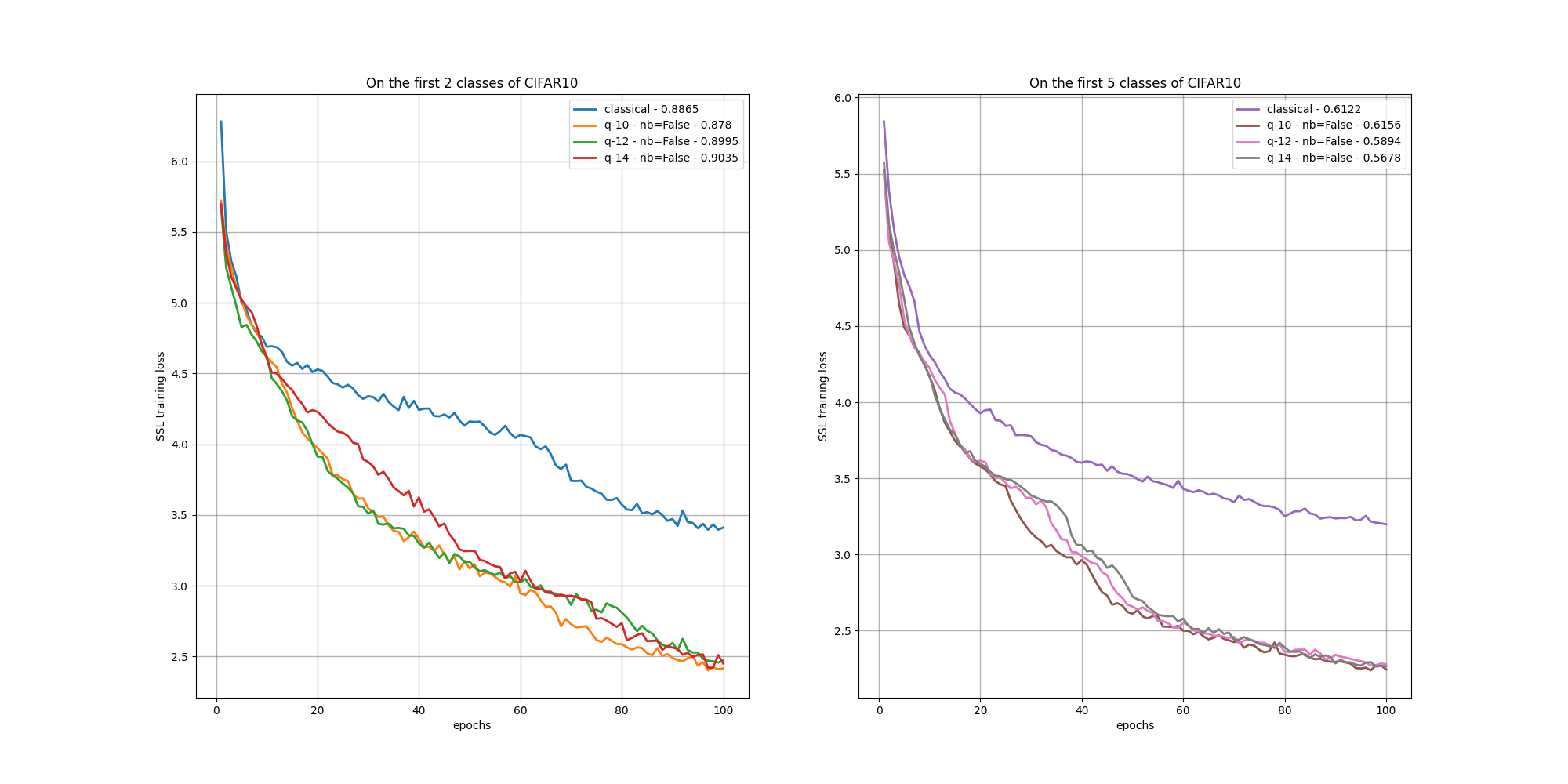
SSL training losses over epochs.
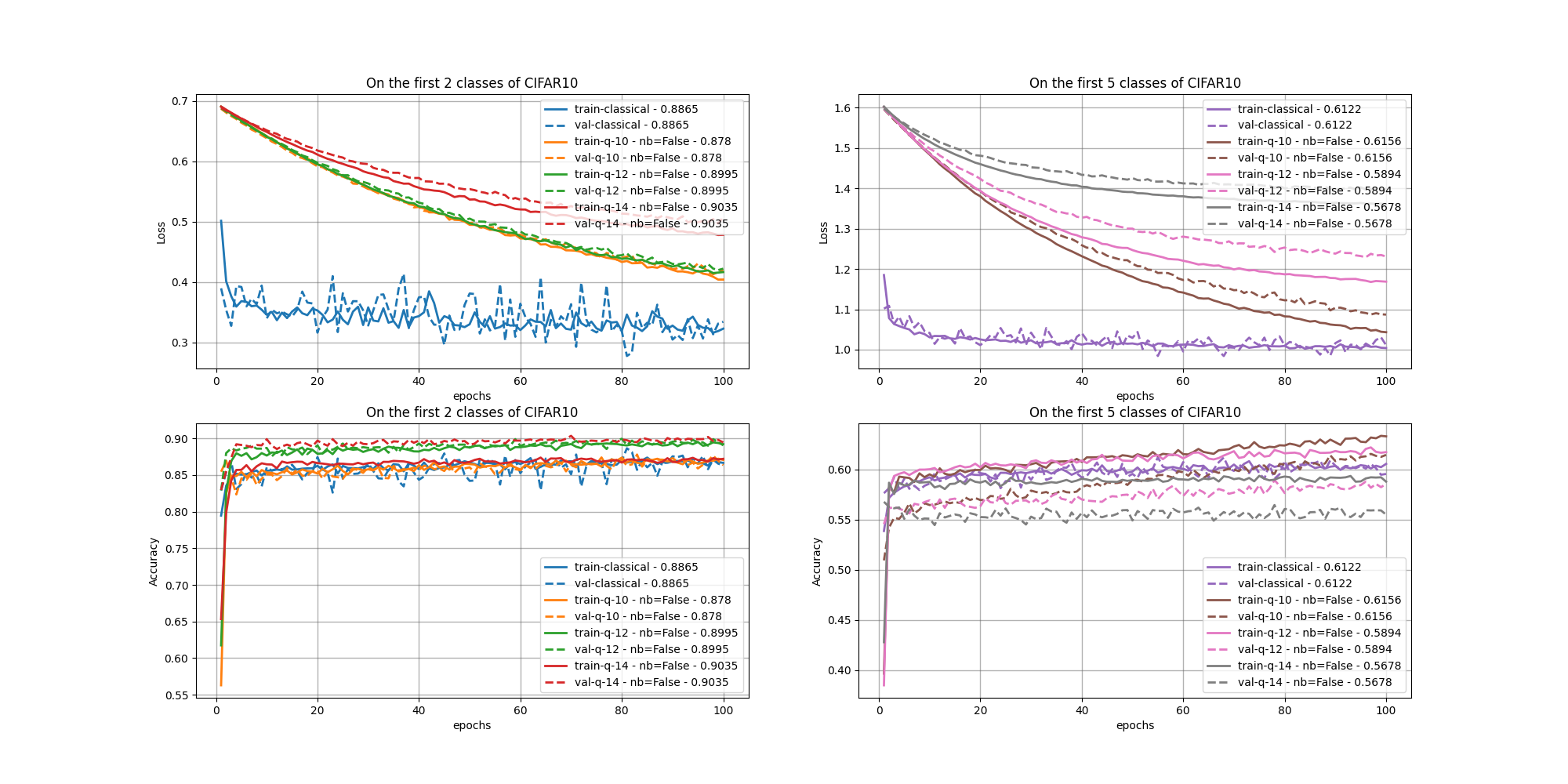
Fine-tuning losses and linear-probe accuracies.
Citation
@article{jaderberg2022quantum,
  title={Quantum self-supervised learning},
  author={Jaderberg, Ben and Anderson, Lewis W and Xie, Weidi and Albanie, Samuel and Kiffner, Martin and Jaksch, Dieter},
  journal={Quantum Science \& Technology},
  volume={7},
  number={3},
  pages={035005},
  year={2022},
  publisher={IOP Publishing}
}