Quantum Large Language Model Fine-Tuning
Paper Information
Title: Quantum Large Language Model Fine-Tuning
Authors: Sang Hyub Kim, Jonathan Mei, Claudio Girotto, Masako Yamada, Marin Roetteler
Published: 2025 IEEE International Conference on Quantum Computing and Engineering (QCE)
DOI: 10.1109/QCE65121.2025.00258
ArXiv: 2504.08732
Reproduction Status: ✅ Complete
Reproducer: Cassandre Notton (cassandre.notton@quandela.com)
Project Repository
Abstract
This work studies hybrid quantum-classical heads for sentence-transformer-based sentiment classification and reports up to 3.14% accuracy gains over classical baselines of comparable size. The reproduced setup uses frozen sentence embeddings and compares classical heads (logistic regression, SVM, MLP) against MerLin photonic quantum heads.
Significance
This paper is relevant because it evaluates trainable quantum heads in a practical NLP pipeline instead of replacing the full LLM backbone. It also reports parameter-count-aware comparisons to classical baselines and explores a broad hyperparameter space.
Key Contributions Reproduced
Reproduced updated classical baselines on SST-2 with 5-fold statistics and parameter counts.
Benchmarked four MerLin photonic variants (basic, parallel, expectation, kernel).
Added experiment-setup and hyperparameter-study artifacts to document the reproduction workflow.
MerLin Implementation
This reproduction focuses on the MerLin photonic variants:
merlin-basic(single encoder / sandwich quantum layer)merlin-parallel(parallel angle-encoding branches)merlin-expectation(expectation-value readout)merlin-kernel(fidelity-kernel approach)
The dataset is SST-2 (SetFit variant), with frozen sentence-transformer embeddings.
Experiment Setup
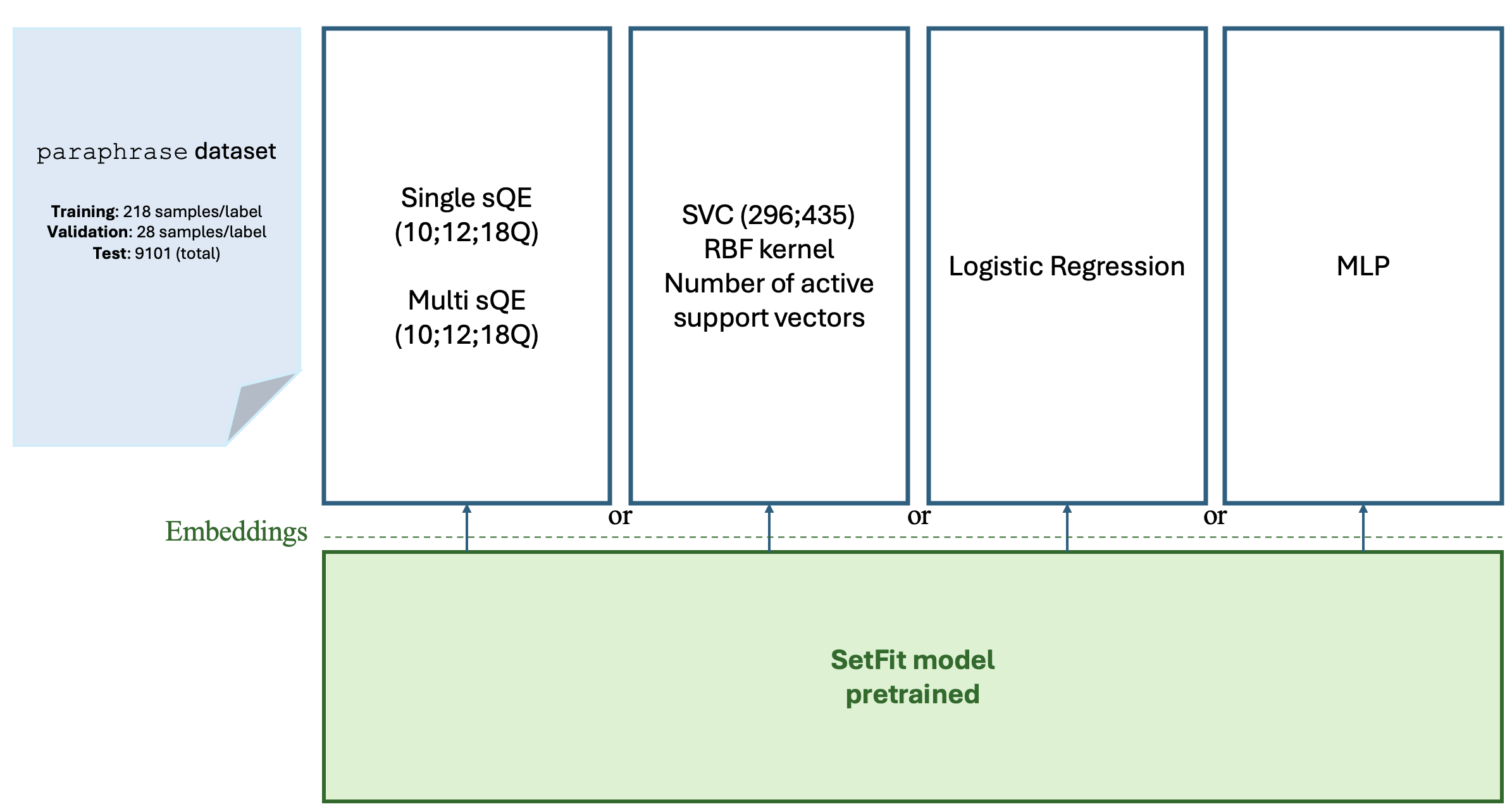
The architecture reproduced from the paper is summarized below.
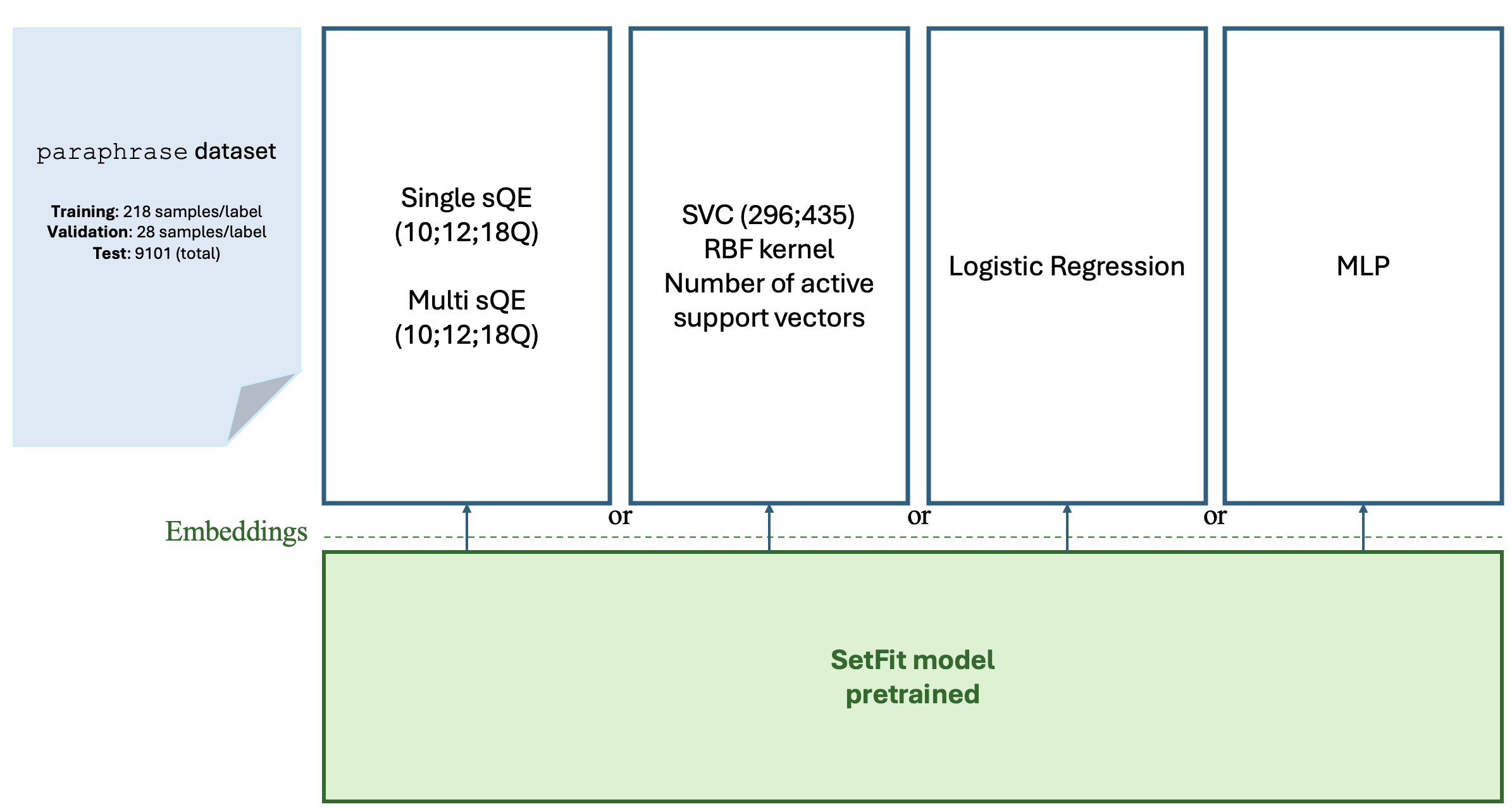
Experimental setup and model pipeline used in the qLLM reproduction.
Embedding Visualization
We additionally visualize the frozen sentence-embedding space with a t-SNE projection.
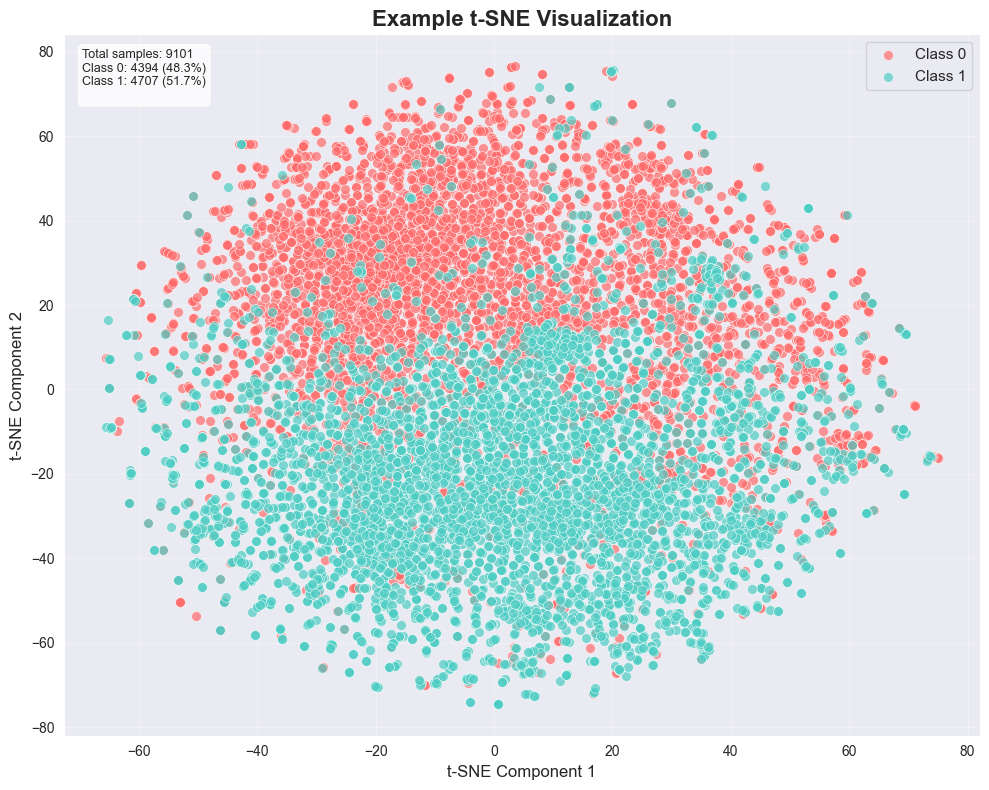
t-SNE projection of the embedding space used for SST-2 classification experiments.
Implementation Details
For a first MerLin analysis, we use a generic interferometer-based quantum layer:
import merlin as ML
import numpy as np
import torch

device = torch.device("cuda" if torch.cuda.is_available() else "cpu")

builder = ML.CircuitBuilder(n_modes=modes)
builder.add_entangling_layer(trainable=True)
builder.add_angle_encoding(
    modes=list(range(X_train.shape[1])),
    scale=np.pi,
)
builder.add_entangling_layer(trainable=True)

q_layer = ML.QuantumLayer(
    input_size=X_train.shape[1],
    builder=builder,
    n_photons=modes // 2,
    measurement_strategy=ML.MeasurementStrategy.probs(),
)
Experimental Results
Claim reproduced from the paper context: up to 3.14% improvement over comparable classical models within the explored hyperparameter range.
Classical baselines (5-fold mean±std, with best test):
Model |
Mean±Std |
Best test |
Params |
|---|---|---|---|
SVM (C=1) |
0.8912 ± 0.0038 |
0.8955 |
296 |
SVM (C=100) |
0.8889 ± 0.0045 |
0.8932 |
435 |
Logistic Regression |
0.8888 ± 0.0043 |
0.8933 |
769 |
NN [0] |
0.8886 ± 0.0043 |
0.8934 |
1,538 |
NN [48] |
0.8897 ± 0.0098 |
0.8946 |
37,010 |
NN [96] |
0.8912 ± 0.0038 |
0.8933 |
74,018 |
NN [144] |
0.8839 ± 0.0034 |
0.8896 |
111,026 |
NN [192] |
0.8827 ± 0.0085 |
0.8901 |
148,034 |
MerLin sweep snapshot (simple QuantumLayer): mode=8, 1 photon gives
0.8874 ± 0.0071 mean accuracy with best test 0.8924.
Best MerLin results by model type (200 epochs):
MerLin model |
Best test accuracy |
Source table |
n_modes |
n_photons |
computation_space |
hidden dim |
|---|---|---|---|---|---|---|
merlin-basic (simple QuantumLayer) |
0.8951 |
simple QuantumLayer |
12 |
1 |
UNBUNCHED |
8 |
merlin-parallel (angle encoding) |
0.8890 ± 0.0069 |
paper-like architecture (angle) |
12 |
4 |
FOCK |
64 |
merlin-expectation (expectation values) |
0.8874 ± 0.0092 |
paper-like architecture + expectation |
12 |
2 |
UNBUNCHED |
128 |
merlin-kernel (fidelity kernel) |
0.7460 ± 0.0060 |
fidelity-kernel approach |
12 |
2 |
FOCK |
n/a |
Note
The merlin-kernel entry reports mean±std from the sweep table; this value is the best mean
observed.
Hyperparameter Study
For the classical NN sweep, we varied learning rate, weight decay, and LR-decay gamma (ExponentialLR), then computed correlations with validation/test accuracy.
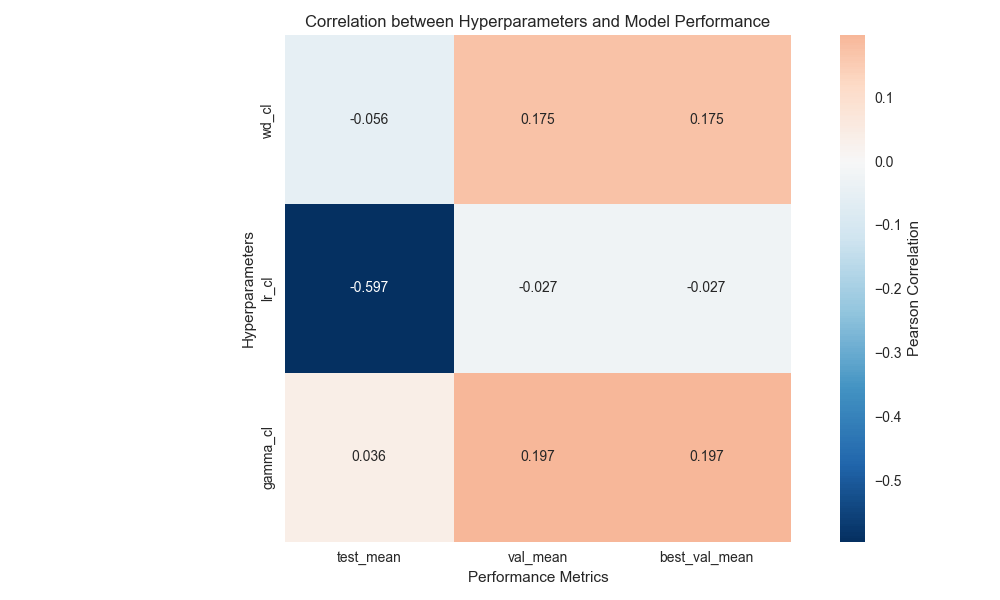
Hyperparameter-study heatmap used to guide classical baseline settings.
Main observations:
Learning rate is the dominant factor in the tested range.
Good settings for the classical NN sweep were:
lr=1e-4,weight_decay=1e-3,gamma=1.Batch normalization degraded test accuracy in this study and was disabled.
Training Curves
Representative training dynamics for the study are shown below.
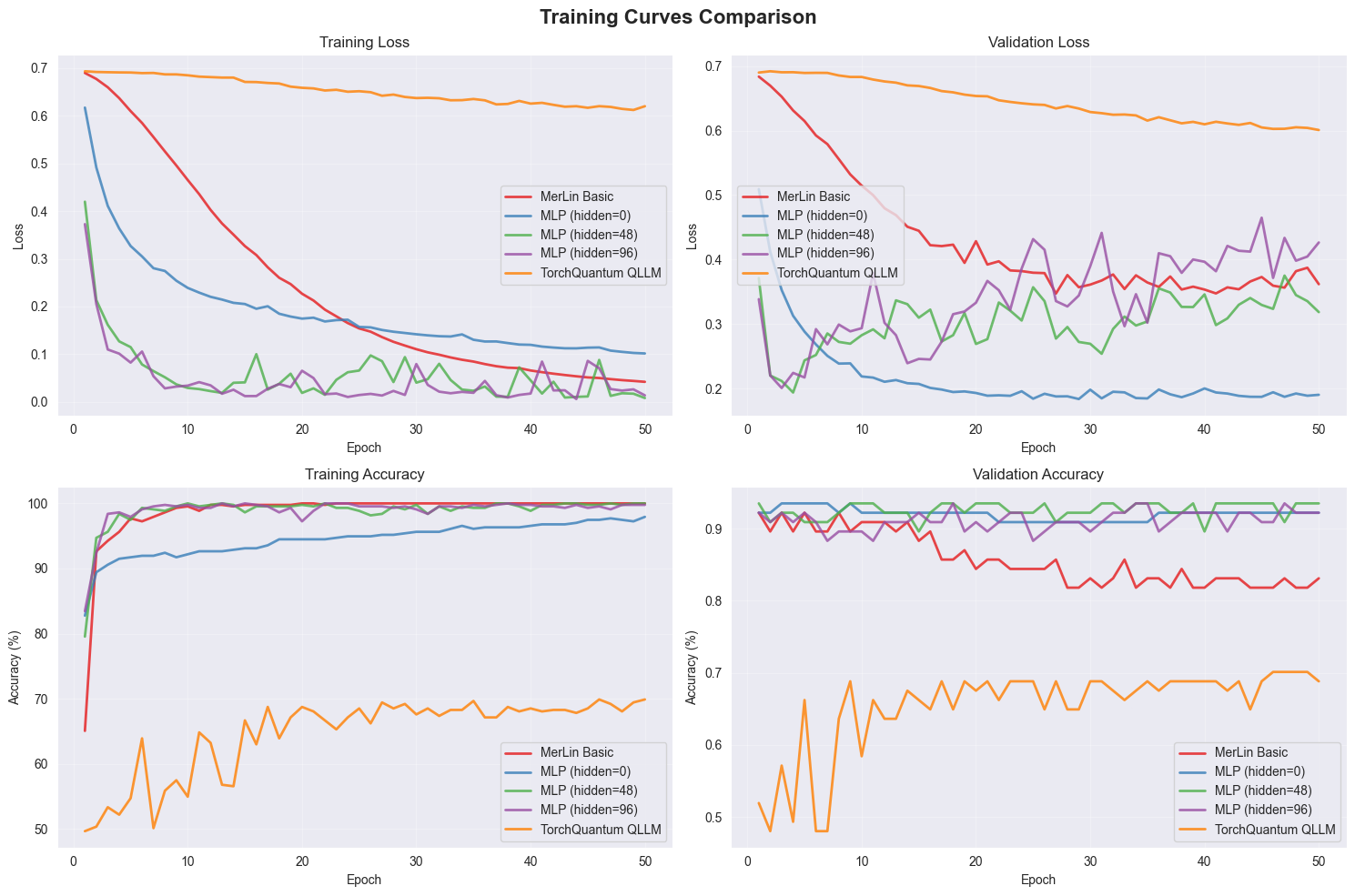
Training and validation curves from the qLLM experiments.
Reproduction Notes
Some paper details are ambiguous and can affect exact parity:
The official split construction differs from standard SetFit splits; we use multiple folds of similar splits.
For multi-encoder settings (
E=2), merge behavior between branches is not fully specified.Final hyperparameter choices after the paper’s full sweep are only partially specified.
This implementation currently does not include noise modeling.
Citation
@article{kim2025quantum,
   title={Quantum Large Language Model Fine-Tuning},
   author={Kim, Sang Hyub and Mei, Jonathan and Girotto, Claudio and Yamada, Masako and Roetteler, Martin},
   journal={arXiv preprint arXiv:2504.08732},
   year={2025}
}