Photonic QGAN
A Generative Adversarial Network (GAN) is a classical neural network that tries to create a model that generates new samples from a given distribution. Here we will present a photonic implementation of this model that is ready-to-use in MerLin. It was first presented in Sedrakyan and Salavrakos’ paper. There is also a reproduction in MerLin of this paper here.
Let’s first understand how a classical GAN works.
Classical GAN
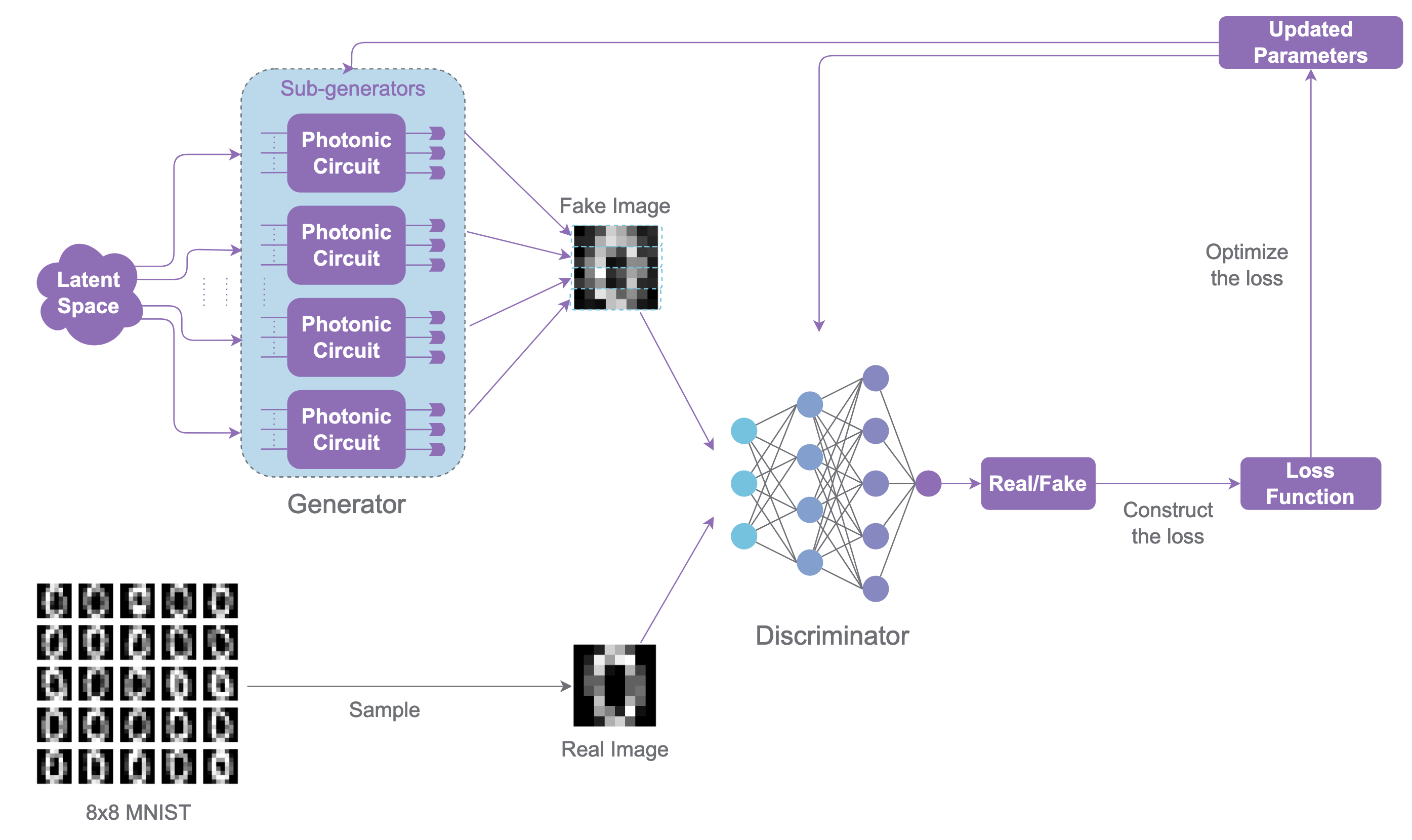
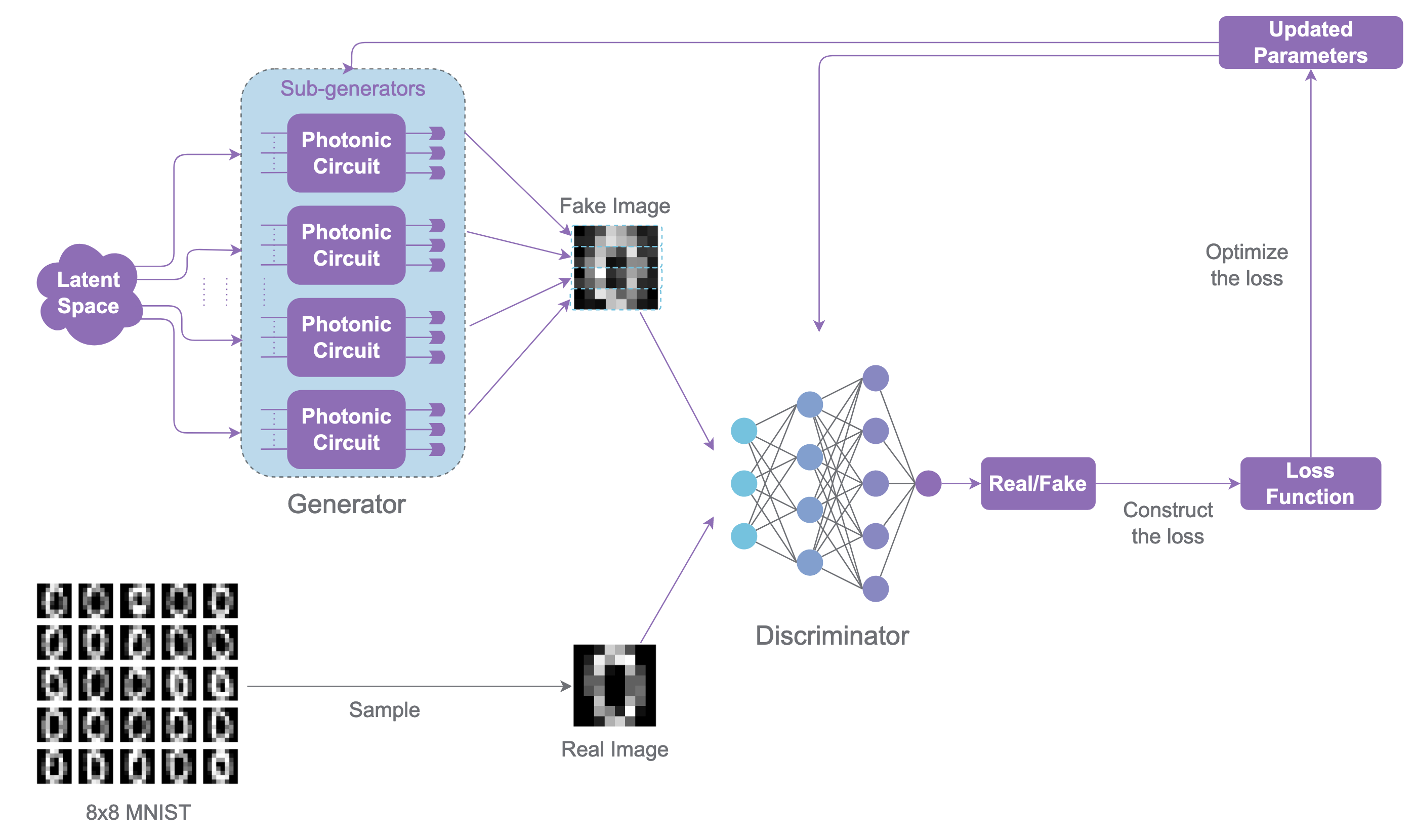
The model is composed of two different submodules: a generator G and a discriminator D which are competing against one another in an adversarial zero-sum game. The generator wants to fool the discriminator with fake images and the discriminator wants to correctly identify fake images versus real images from the dataset. The generator receives random noise values as input and transforms them to fake images of the dataset. The model can be identified in the next figure where we can just consider the generator as a whole classical model without the quantum sub generators.
The GAN has a specific training routine. The main steps are:
For a number of
iterations:For a number of discriminator iterations
d_steps:Train the discriminator parameters with batches of fake and real images. The labels of the real values are
real_labelsand the fake images’ labels arefake_labels.After hyperparameter optimization, we choose:
real_labels = 0.9fake_labels = 0.0
For a number of generator iterations
g_steps:Train the generator parameters using only its generated fake images, which are classified by the discriminator. The associated labels are
generator_labels.After hyperparameter optimization, we choose:
generator_labels = 0.9
The loss calculations for both steps are:
Discriminator training’s loss
\[\mathcal{L}_D = \frac{1}{n}\sum_{i=1}^{n} \mathrm{Loss}\!\left(D(x_i), \text{real labels}\right) + \frac{1}{n}\sum_{i=1}^{n} \mathrm{Loss}\!\left(D(G(z_i)), \text{fake labels}\right)\]where \(x_i\) are the real images in the batch and \(z_i\) are the noise vectors generated for the batch.
Generator training’s loss
\[\mathcal{L}_G = \frac{1}{n}\sum_{i=1}^{n} \mathrm{Loss}\!\left(D(G(z_i)), \text{generator labels}\right)\]where \(z_i\) are the noise vectors generated for the batch.
For the photonic QGAN, the preferred loss function is
torch.nn.BCEWithLogitsLoss from PyTorch.
Photonic QGAN
The photonic implementation of the QGAN is similar. Just like it is illustrated in the figure above, the generator will be composed of multiple photonic circuits that will be run together to generate brand new images. The concept and training of the GAN model stays the same.
MerLin implementation
The ready-to-use MerLin model creats the generator. It is defined as the PhotonicGenerator object. This model takes noise as input and generates new features that are close to the data distribution as an output.
By default, sample_latent and generate draw normal latent vectors from
PyTorch’s global random-number generator. For reproducible batches, pass a
dedicated torch.Generator. The same generator can be supplied to
generate during evaluation or to sample_latent when the latent batch is
also needed:
sampling_generator = torch.Generator().manual_seed(1234)
fake_images = generator.generate(
    batch_size=32,
    generator=sampling_generator,
)
Using a dedicated generator keeps latent sampling reproducible without advancing PyTorch’s global random-number generator. The generator must be compatible with the device used for sampling.
There is also a helper classes to help transform the output.
ImageAdapter: Adapt tensor measurements to GAN-native image tensors.VectorAdapter: Concatenate tensor measurements into fixed-width vectors.
Although the PhotonicGenerator’s output adapter argument can accept a regular torch module as well.
For more information on the specifications of these objects, please consult the api: merlin.models.photonic_generator module.
Tutorial
A tutorial on the use of the PhotonicGenerator to create a photonic QGAN is available by clicking on the next window.