Photonic QCNN
The QCNNClassifier is a ready-to-use photonic
quantum convolutional neural network for square, single-channel image
classification. It follows the photonic QCNN architecture with adaptive state
injection introduced by Monbroussou et al. in Photonic Quantum Convolutional
Neural Networks with Adaptive State Injection, Advanced Photonics, 7(6),
066012, 2025.
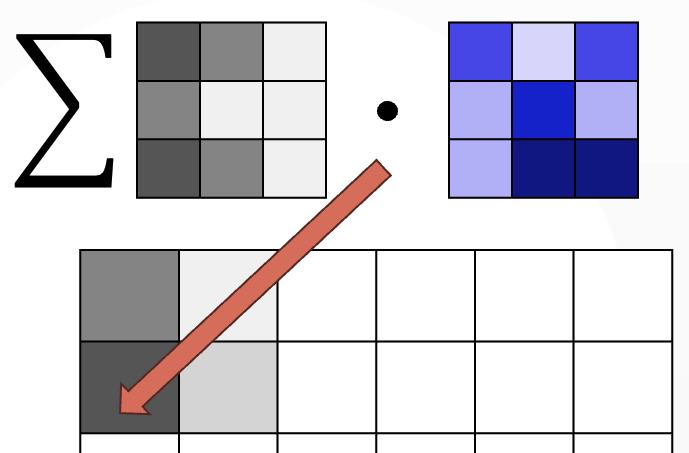
From an ML perspective, the model can be read as the quantum analogue of a compact CNN:
image values are amplitude-encoded into a two-register photonic state;
QConvlayers apply local trainable filters with shared parameters;QPoollayers reduce the register size through measurement and state injection;QDensemixes the remaining modes before a classical linear readout returns logits.
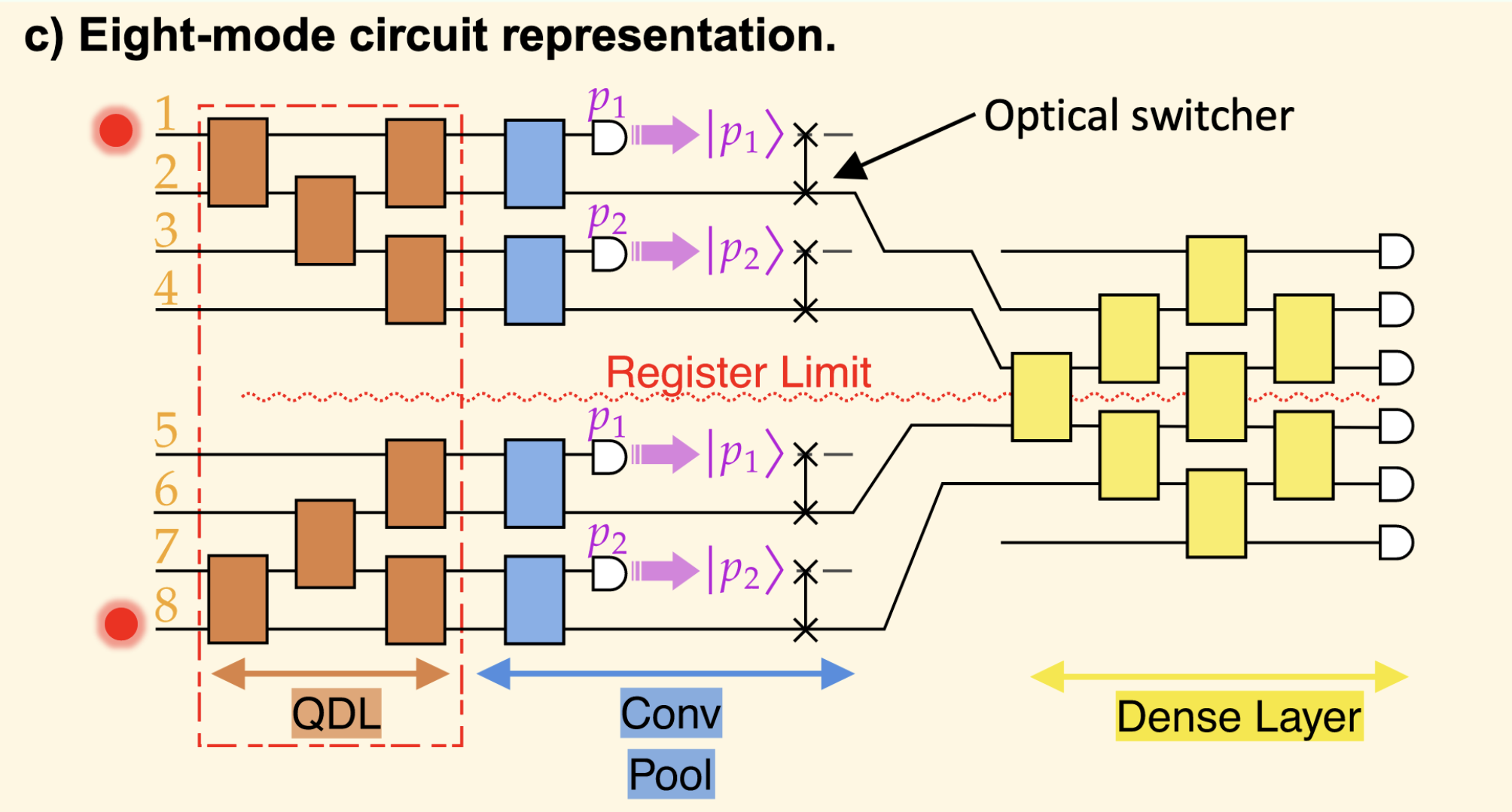
Image taken from the original paper.
Input Encoding
QCNNClassifier expects tensors with shape (batch_size, 1, height, width).
The spatial shape must be square and must match the input_shape passed to the
model.
Before the first layer, each image is converted to a normalized two-photon state vector. The row index is encoded in the first register and the column index is encoded in the second register:
For a 4 x 4 image, the model uses 8 modes: 4 row modes and 4
column modes. A pixel x[i, j] becomes the amplitude of the Fock basis state
with one photon in row mode i and one photon in column mode 4 + j. Basis
states that do not respect this one-photon-per-register structure receive zero
amplitude.
Architecture
The default architecture is:
QCNNClassifier(
    input_shape=(4, 4),
    num_classes=2,
    stages=None,
)
When stages is omitted, MerLin resolves it to:
[
    QCNNClassifier.QConv(kernel_size=2, stride=2),
    QCNNClassifier.QPool(kernel_size=2),
    QCNNClassifier.QDense(),
]
The executable model is a torch.nn.Sequential stored in
model.layers. For the default architecture, its named modules are:
QConv_1 -> QPool_1 -> QDense -> Readout
QConv_1, QPool_1, and QDense are
QuantumLayer instances. Readout is a
torch.nn.Linear layer that maps the dense quantum probabilities to
num_classes logits.
Quantum Convolution Layer
QCNNClassifier.QConv(kernel_size, stride) builds local trainable photonic
filters. The layer works separately on the row and column registers, so no beam
splitter directly mixes row modes with column modes during convolution.
For each register:
a sliding window covers
kernel_sizeadjacent modes;consecutive windows start
stridemodes apart;each window is implemented by a down-and-up mesh of trainable beam splitters;
all windows in the same register share one trainable parameter.
The two registers use distinct trainable parameters:
px_first_register
px_second_register
This is the photonic equivalent of a classical convolutional filter with parameter sharing. It mixes local neighborhoods while preserving the two-register tensor-encoding structure. The layer returns amplitudes, not class scores, so later quantum layers can continue processing a state vector.
The convolution specification must satisfy:
kernel_size > 1;stride > 0;kernel_size <= current_register_size;stride <= kernel_size.
Quantum Pooling Layer
QCNNClassifier.QPool(kernel_size) reduces the number of modes in each
register. It is the state-injection layer of the photonic QCNN.
For every pooling window, MerLin measures the first mode. If the measured mode contains a photon, the post-processing reinserts one photon in the adjacent mode of the reduced register. Each valid measurement branch is then propagated through the remaining layers, and the branch logits are combined with their measurement probabilities.
For an input register of size d and a pooling kernel k, the current
implementation reduces the register size to:
With the default kernel_size=2, pooling halves each register. A 4 x 4
input encoded on 4 + 4 modes therefore reaches the dense layer with 2 + 2
modes.
The pooling specification must satisfy:
kernel_size > 1;current_register_size % kernel_size == 0.
Quantum Dense Layer and Readout
QCNNClassifier.QDense() is mandatory and must be the final quantum stage.
It builds a trainable beam-splitter mesh over all remaining modes, merging the
row and column information before measurement.
The dense quantum layer returns Fock-basis probabilities. MerLin then applies a classical linear readout:
torch.nn.Linear(qdense.output_size, num_classes)
The model output is a tensor of logits with shape (batch_size, num_classes).
Use the same loss functions as with regular PyTorch classifiers, for example
torch.nn.CrossEntropyLoss.
Custom Stage Sequences
You can define a deeper QCNN by passing an explicit stage list:
from merlin.models import QCNNClassifier

model = QCNNClassifier(
    input_shape=(4, 4),
    num_classes=2,
    stages=[
        QCNNClassifier.QConv(kernel_size=2, stride=1),
        QCNNClassifier.QConv(kernel_size=2, stride=2),
        QCNNClassifier.QDense(),
    ],
)
Custom stages must follow these rules:
the list cannot be empty;
only
QConv,QPool, andQDensestage objects are accepted;exactly one
QDensemust appear, and it must be the last stage;each
QConvandQPoolmust be compatible with the current register size after previous pooling stages.
The resolved stage list is available through model.resolved_stages. The
actual executable layers are available through model.layers.
Training Example
QCNNClassifier is a standard torch.nn.Module, so training uses the
regular PyTorch workflow.
import torch

from merlin.models import QCNNClassifier

model = QCNNClassifier(input_shape=(4, 4), num_classes=2)
optimizer = torch.optim.Adam(model.parameters(), lr=1e-2)
loss_function = torch.nn.CrossEntropyLoss()

x = torch.rand(16, 1, 4, 4)
y = torch.randint(0, 2, (16,))

optimizer.zero_grad()
logits = model(x)
loss = loss_function(logits, y)
loss.backward()
optimizer.step()
Be advised that RAM consumption exhibits quadratic growth relative to the input size. Exceeding dimensions of (24,24) can lead to performance degradation or system crashes.