Nearest Centroid Classification on a Trapped Ion Quantum Computer
Paper Information
Title: Nearest Centroid Classification on a Trapped Ion Quantum Computer
Authors: Sonika Johri, Shantanu Debnath, Avinash Mocherla, Alexandros Singh, Anupam Prakash, Jungsang Kim, Iordanis Kerenidis
Published: arXiv preprint (2020)
DOI: arXiv:2012.04145
Reproduction Status: Complete
Reproducer: Benjamin Stott (benjamin.stott@quandela.com)
Project Repository
Abstract
This paper proposes a quantum algorithm for nearest centroid classification, a distance-based machine learning method, and demonstrates it on an IonQ trapped-ion quantum processor. The core contribution is a quantum inner product estimation circuit that encodes classical vectors into quantum states using amplitude encoding, achieving an asymptotic speedup of \(O(k \log d)\) over the classical \(O(kd)\) cost for \(d\)-dimensional data with \(k\) classes.
The algorithm uses unary amplitude encoding with Reconfigurable Beam Splitter (RBS) gates arranged in a logarithmic-depth binary tree structure. By measuring the probability of a photon returning to its initial mode after encoding both a test point and a class centroid, the circuit estimates their inner product, from which Euclidean distance is derived. The paper validates this approach on synthetic, Iris, and MNIST datasets, demonstrating that the quantum classifier matches classical accuracy under ideal conditions and characterises the effect of hardware noise and post-selection error mitigation.
Significance
This paper is significant for the photonic quantum ML field because it provides one of the first end-to-end experimental demonstrations of a quantum classifier on real quantum hardware. It establishes a concrete data loading primitive - the RBS binary tree - that encodes a \(d\)-dimensional vector in \(O(\log d)\) circuit depth using a single photon, a technique that has since become foundational in linear optical quantum ML. The post-selection error mitigation strategy described also serves as a template for handling hardware noise in near-term photonic devices.
MerLin Implementation
MerLin’s QuantumLayer is used as a drop-in quantum distance oracle inside scikit-learn’s
NearestCentroid classifier. The QuantumLayer operates in the unbunched single-photon
regime (ComputationSpace.UNBUNCHED) and returns measurement probabilities over basis
states (MeasurementStrategy.probs()). The RBS binary-tree circuit is constructed
programmatically from the input dimension, and the angle encoding for both the test vector
and the reference centroid is concatenated and passed as the input_parameters. No
trainable parameters are used - the circuit is entirely data-driven.
A parallel Cirq-based reference implementation is included, enabling direct comparison between MerLin and the paper’s original ideal simulation.
Key Contributions
- Quantum inner product estimation and nearest centroid classification
We have implemented unary amplitude encoding of \(d\)-dimensional vectors into \(d\) photonic modes using a single photon and an RBS binary-tree circuit of depth \(O(\log d)\). We have shown that the inner product between two vectors can be estimated by measuring the probability of a photon returning to mode 0 after applying the loader for \(\mathbf{x}\) followed by the inverse loader for \(\mathbf{y}\), and that Euclidean distance can be recovered from this estimate.
We have validated multiclass nearest centroid classification on synthetic Gaussian clusters, the Iris dataset (3 classes, 4 features), and MNIST (binary and multiclass configurations up to 4 classes), with PCA preprocessing to reduce high-dimensional inputs to a power-of-2 number of components as required by the RBS circuit structure.
- MerLin and Cirq parity
We have demonstrated that MerLin’s
QuantumLayerproduces results statistically identical to the Cirq reference simulator across all datasets and configurations. Differences between the two backends are within one standard deviation and attributable solely to shot noise, confirming correctness of the MerLin implementation.
Implementation Details
The QuantumNearestCentroid classifier (Cirq backend) and MLQuantumNearestCentroid
classifier (MerLin backend) both subclass scikit-learn’s NearestCentroid, overriding
only the distance metric:
from merlin import ComputationSpace, MeasurementStrategy, QuantumLayer
from sklearn.neighbors import NearestCentroid
from lib.utils import create_circuit, get_angles
import torch, numpy as np

n = 8  # number of modes (must be power of 2)
circuit = create_circuit(n)  # RBS binary-tree circuit

layer = QuantumLayer(
    input_size=2 * (n - 1),
    circuit=circuit,
    trainable_parameters=[],
    input_parameters=["theta"],
    input_state=[1] + [0] * (n - 1),
    computation_space=ComputationSpace.UNBUNCHED,
    measurement_strategy=MeasurementStrategy.probs(),
)

class MLQuantumNearestCentroid(NearestCentroid):
    def get_metric(self, x, y):
        norm_x, norm_y = np.linalg.norm(x), np.linalg.norm(y)
        angles = torch.cat((2 * get_angles(x), -2 * get_angles(y).flip(0)))
        inner = layer(angles, shots=1000, sampling_method="multinomial").sqrt()[0]
        return np.sqrt(norm_x**2 + norm_y**2 - 2 * norm_x * norm_y * inner.item())

    def __init__(self, n=8, repetitions=500):
        self.layer = layer
        super().__init__(metric=self.get_metric)
Before each experiment, data is preprocessed through a fixed pipeline: optional stratified
subsampling, a 50/50 stratified train/test split, PCA reduction to n_components, and
MinMax scaling to [0, 1]. The classical NearestCentroid baseline uses PCA features
without scaling, consistent with the paper.
Experimental Results
Synthetic Data (Paper Figure 8)
Gaussian clusters generated on the unit sphere with controlled centroid separation
(min_centroid_distance = 0.3, gaussian_variance = 0.05), 10 points per cluster,
averaged over 10 repeated splits.
Config |
Shots |
Classical |
Cirq |
MerLin |
|---|---|---|---|---|
Nq=4, Nc=2 |
100 |
100.0 % |
100.0 % |
99.0 % |
Nq=4, Nc=4 |
500 |
94.5 % |
94.5 % |
93.5 % |
Nq=8, Nc=2 |
1000 |
85.0 % |
79.0 % |
79.0 % |
Nq=8, Nc=4 |
1000 |
94.0 % |
93.0 % |
92.5 % |
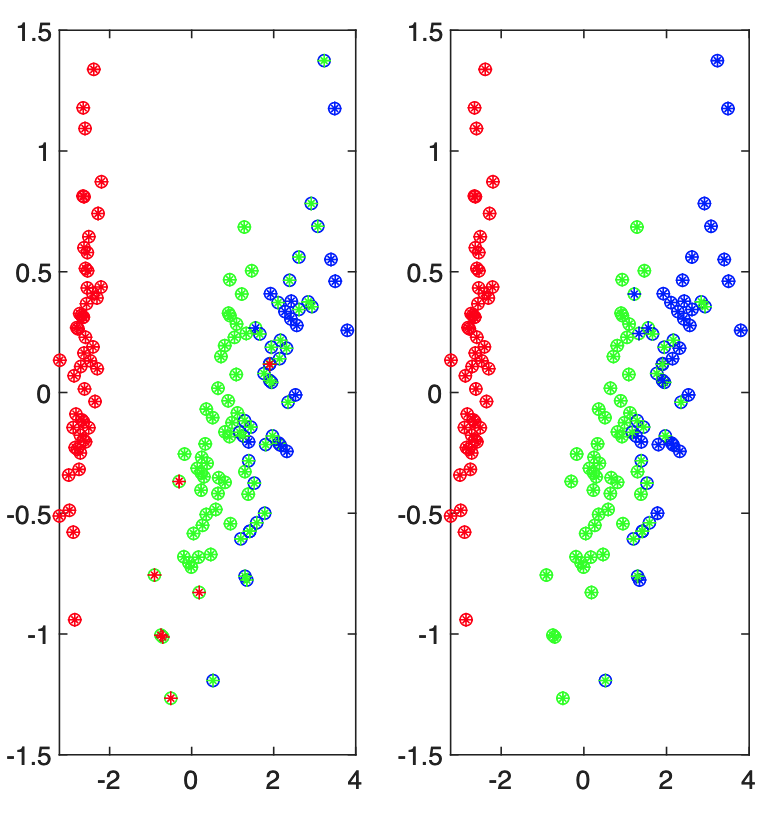
IRIS Dataset (Paper Figure 9)
Fisher Iris dataset (150 samples, 4 features, 3 classes). No PCA required since the data is already 4-dimensional (Nq=4). Shot count is swept to illustrate the effect of measurement statistics on accuracy.
Shots |
Classical |
Cirq |
MerLin |
|---|---|---|---|
100 |
93.5 % |
91.7 % |
91.9 % |
500 |
93.5 % |
91.5 % |
91.9 % |
1000 |
93.5 % |
92.4 % |
92.0 % |
MNIST Dataset (Paper Figure 11)
MNIST images reduced from 784 pixels to 8 PCA components (Nq=8), 1000 shots.
Task |
Classical |
Cirq |
MerLin |
|---|---|---|---|
Digits 0 vs 1 |
99.0 % |
98.8 % |
99.5 % |
Digits 2 vs 7 |
94.2 % |
93.7 % |
95.5 % |
4-class (digits 0-3) |
87.9 % |
88.8 % |
88.2 % |
Code Access and Documentation
GitHub Repository: merlin/reproductions/nearest_centroids
Extensions and Future Work
The MerLin implementation extends beyond the original paper:
- Enhanced Capabilities
Both a Cirq reference backend and a MerLin
QuantumLayerbackend are provided, enabling direct numerical comparison of the two frameworks on identical inputs.Per-experiment prediction arrays are saved to JSON, supporting fine-grained analysis of agreement between backends at the individual sample level.
Hyperparameters (
n_shots,n_repeats,n_components,max_samples) are fully configurable via JSON config files without code changes.
- Experimental Extensions
Shot-count sweep on the Iris dataset (100, 500, 1000 shots) extends the paper’s single reported configuration.
4-class MNIST extends the binary tasks in the original paper.
Synthetic data generation with controllable cluster separation and Gaussian variance allows systematic study of how data geometry affects quantum vs. classical accuracy.
- Hardware Considerations
All experiments run on CPU with no GPU requirement.
The 10-class MNIST experiment (400 samples x 1000 shots x 10 repeats) is computationally expensive and is disabled by default (
RUN_10CLASS = False).The
error_rateanderror_mitigationparameters in both classifiers are ready for hardware noise experiments without code changes.
- Future Work
Noise-aware experiments building on the error model in
lib/noise.pywould complement the hardware results in the original paper and validate the post-selection error mitigation strategy against a realistic noise model.
Citation
@article{johri2020nearest,
  title={Nearest Centroid Classification on a Trapped Ion Quantum Computer},
  author={Johri, Sonika and Debnath, Shantanu and Mocherla, Avinash and Singh, Alexandros
          and Prakash, Anupam and Kim, Jungsang and Kerenidis, Iordanis},
  journal={arXiv preprint arXiv:2012.04145},
  year={2020}
}