Experimental data re-uploading with provable enhanced learning capabilities
Paper Information
Title: Experimental data re-uploading with provable enhanced learning capabilities
Authors: Martin F. X. Mauser, Solène Four, Lena Marie Predl, Riccardo Albiero, Francesco Ceccarelli, Roberto Osellame, Philipp Petersen, Borivoje Dakić, Iris Agresti, and Philip Walther
Published: arXiv preprint, 14 (2025)
DOI: https://doi.org/10.48550/arXiv.2507.05120
Reproduction Status: ✅ Complete
Reproducer: Hugo Izadi (hugoizadi@gmail.com) and Philippe Schoeb (philippe.schoeb@quandela.com)
Project Repository
Abstract
The reference paper’s main contribution is to present a well performing and resource-efficient data re-uploading scheme on a photonic quantum processor. It showcases the model’s performance on four datasets of increasing complexity. It also provides an analytical proof that the proposed model in a universal classifier.
Significance
This research is significant since it proposes a resource-efficient model that could reduce ernegy consumption for classifying tasks. In addition, energy efficiency is becoming an increasingly important argument for using quantum circuits in machine learning.
MerLin Implementation
MerLin’s QuantumLayer is used in our reproduction to define the optimizable photonic circuit that comprises almost all the proposed model.
Key Contributions Reproduced
- Effect of increasing number of re-uploading layers on the circular dataset
Three re-uploading layers are necessary to fully capture the expressivity of the circular dataset
- Experimental accuracies or the photonic data re-uploading model on four different datasets based on its number of layers
Increasing number of layers increases the obtained train and test accuracies
Faster improvement of accuracy when increasing number of layers on the Tetromino dataset
Slower improvement of accuracy when increasing number of layers on the circular dataset
Implementation Details
The trainable photonic circuit used to encode data is defined with MerLin:
import merlin as ml

quantum_layer = ml.QuantumLayer(
    input_size=self.dimension,
    circuit=circuit_model.circuit,
    trainable_parameters=["var"],
    input_parameters=["x"],
    input_state=circuit_model.input_state,
    measurement_strategy=ml.MeasurementStrategy.probs(),
)
Extensions and Future Work
The MerLin implementation extends beyond the original paper:
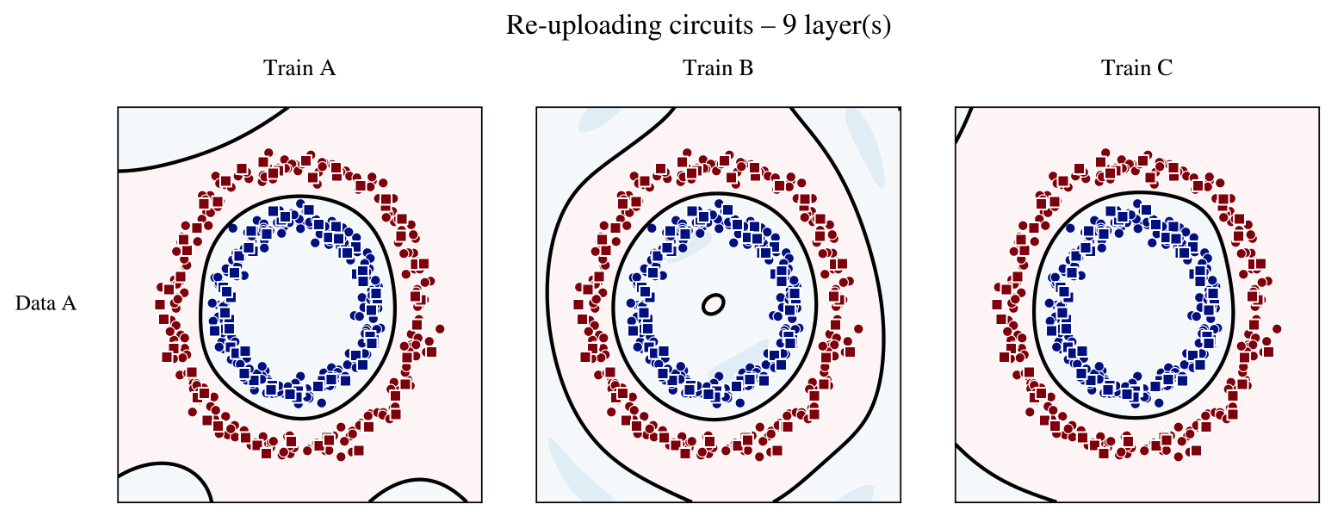
- Circuit architecture benchmark
Three different circuit schemes were explored for data encoding and for training
Design C is clearly defective
- Hyperparameter grid search
Exploration for different values of tau (Fisher loss temperature) and alpha (phase scaling)
Trade off between too simple and too complex decision boundaries
- Hardware Considerations
Every experiment done for this reproduction has been designed for simulation on CPU
- Future work
Extend to more complex datasets to see the limit of this architecture (if there is any)
Compare with classical baseline models
Deploy on quantum hardware
Code Access and Documentation
GitHub Repository: merlin/reproductions/data_reuploading
The complete implementation includes:
Model implementation
Testing on the four dataset used
Two additional benchmarking
A notebook to explore with the proposed architecture in different settings
Citation
@misc{mauser2025experimentaldatareuploadingprovable,
   title={Experimental data re-uploading with provable enhanced learning capabilities},
   author={Martin F. X. Mauser and Solène Four and Lena Marie Predl and Riccardo Albiero and Francesco Ceccarelli and Roberto Osellame and Philipp Petersen and Borivoje Dakić and Iris Agresti and Philip Walther},
   year={2025},
   eprint={2507.05120},
   archivePrefix={arXiv},
   primaryClass={quant-ph},
   url={https://arxiv.org/abs/2507.05120},
}