Noisy simulations with SLOS
Why use noisy simulations?
Current photonic processors are noisy. A model trained only with ideal simulation can therefore learn from output probabilities that are cleaner than the probabilities produced by the hardware.
Merlin can add the main Quandela hardware noise sources to SLOS simulations
through pcvl.NoiseModel. This makes the training distribution
closer to the distribution expected from the QPU.
The user-facing rule is simple: noisy simulations return probabilities. They do not return ideal amplitudes, because the noise model changes probability distributions.
Run a noisy QuantumLayer
Create a pcvl.NoiseModel and attach it either to the
pcvl.Experiment or directly to
QuantumLayer.
import perceval as pcvl
import torch

import merlin as ML

circuit = pcvl.Circuit(3)
circuit.add((0, 1), pcvl.BS())
circuit.add(0, pcvl.PS(pcvl.P("px")))
circuit.add((1, 2), pcvl.BS())

noise = pcvl.NoiseModel(
    brightness=0.85,
    transmittance=0.9,
    indistinguishability=0.95,
    g2=0.02,
    g2_distinguishable=False,
    phase_imprecision=0.01,
    phase_error=0.02,
)

layer = ML.QuantumLayer(
    input_size=1,
    circuit=circuit,
    input_parameters=["px"],
    input_state=[1, 1, 1],
    noise=noise,
    n_phase_error_samples=10,
    measurement_strategy=ML.MeasurementStrategy.probs(
        computation_space=ML.ComputationSpace.FOCK
    ),
)

x = torch.rand(3, 1)
probabilities = layer(x)
The same noise model can be stored in the experiment instead:
experiment = pcvl.Experiment(circuit, noise=noise)

layer = ML.QuantumLayer(
    input_size=1,
    experiment=experiment,
    input_parameters=["px"],
    input_state=[1, 1, 1],
    n_phase_error_samples=10,
    measurement_strategy=ML.MeasurementStrategy.probs(
        computation_space=ML.ComputationSpace.FOCK
    ),
)
If both the experiment and the layer define a noise model, they must be the same.
Supported noise sources
The active hardware noise sources are split into three groups.
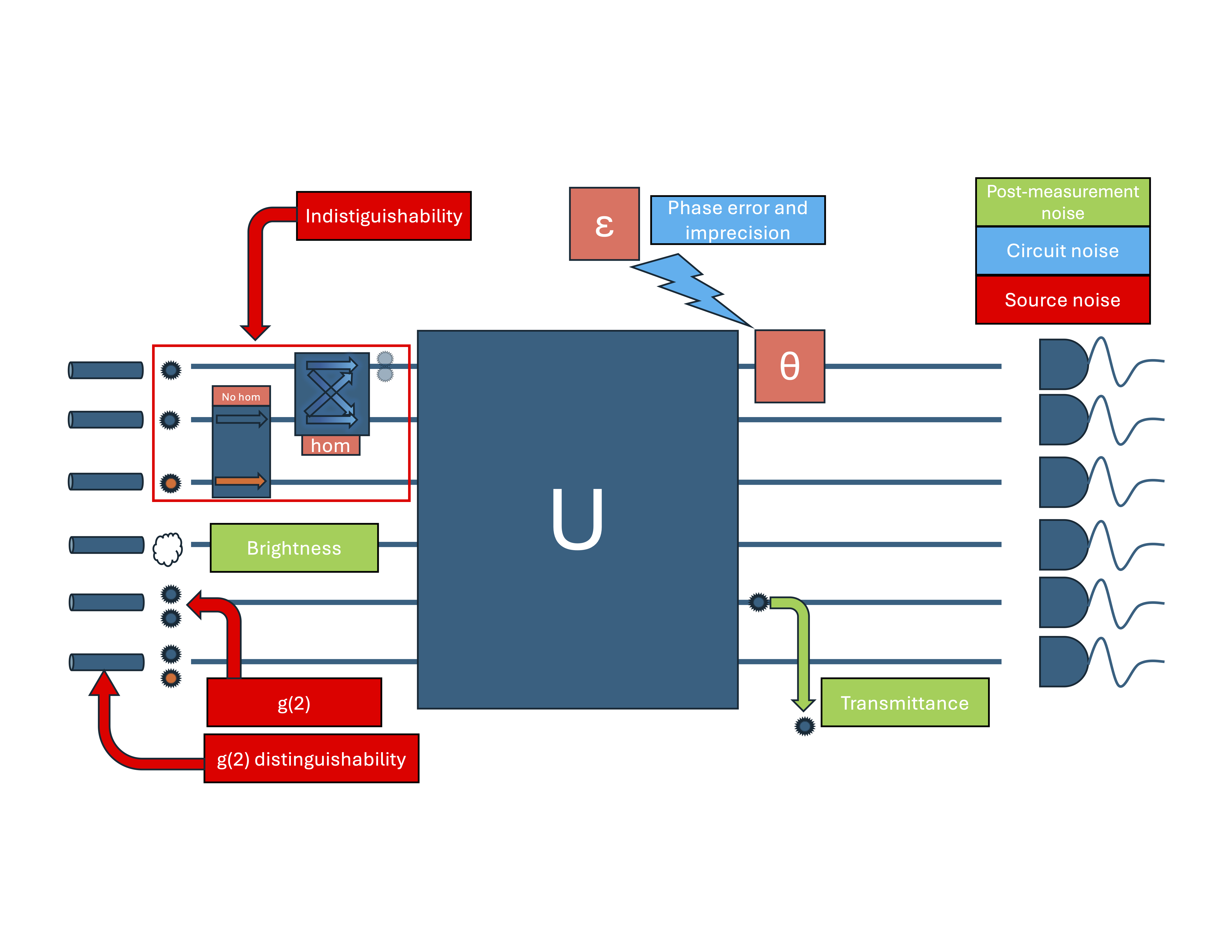
Noise source |
Parameter |
Default |
Practical effect |
|---|---|---|---|
Brightness |
|
|
The source sometimes emits no photon. |
Transmittance |
|
|
A photon can be lost while crossing the processor. |
Phase imprecision |
|
|
Phase shifter values are rounded to a finite resolution. |
Phase error |
|
|
Phase shifter values receive a random perturbation. |
Indistinguishability |
|
|
Photons can become partially distinguishable and interfere less. |
Multi-photon emission |
|
|
A source can emit an extra photon. |
Multi-photon distinguishability |
|
Perceval default |
Extra photons from |
Post-measurement noise
Brightness and transmittance both model missing photons. Their product is the probability that one expected photon is emitted and survives the processor.
Use lower values when you want the output distribution to include states with fewer photons than the ideal input state.
noise = pcvl.NoiseModel(
    brightness=0.8,
    transmittance=0.9,
)
For an input state with n photons, the output basis can contain sectors from
0 to n photons.
Circuit noise
Circuit noise changes the phases used by the interferometer.
phase_imprecision models finite phase-shifter resolution. If
phase_imprecision=0.1, the phase used in the forward pass is the nearest
multiple of 0.1 radians.
noise = pcvl.NoiseModel(phase_imprecision=0.1)
phase_error models random phase fluctuations. For each phase-error sample,
Merlin perturbs the phase shifters, computes the probability distribution, and
then averages the sampled probability distributions.
noise = pcvl.NoiseModel(phase_error=0.02)

layer = ML.QuantumLayer(
    input_size=1,
    circuit=circuit,
    input_parameters=["px"],
    input_state=[1, 0, 1],
    noise=noise,
    n_phase_error_samples=20,
    measurement_strategy=ML.MeasurementStrategy.probs(
        computation_space=ML.ComputationSpace.FOCK
    ),
)
Set torch.manual_seed before calling the layer if you need reproducible
phase-error samples.
Source noise
Source noise changes the photon state before it enters the interferometer.
Indistinguishability
indistinguishability is the probability that emitted photons are identical
enough to interfere. The perfect value is 1.0. Smaller values reduce quantum
interference and move the result toward a classical distribution.
A simple Hong-Ou-Mandel experiment shows the effect. Two indistinguishable photons entering a 50:50 beam splitter bunch together: both photons leave in the same mode.
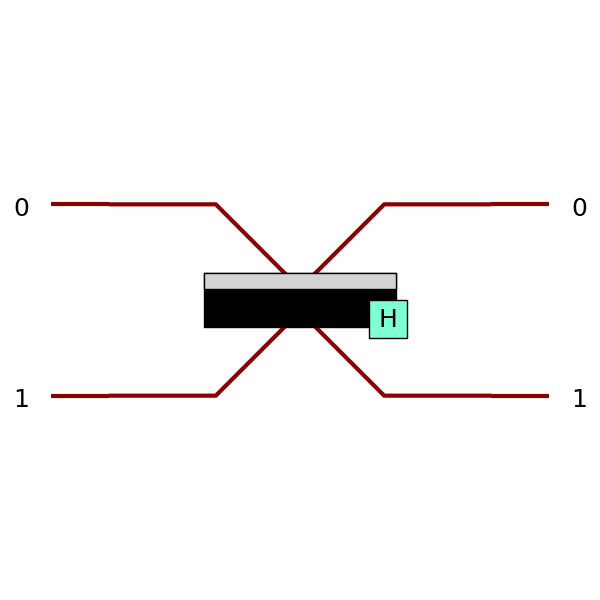
import perceval as pcvl

import merlin as ML

circuit = pcvl.Circuit(2)
circuit.add((0, 1), pcvl.BS.H())

layer = ML.QuantumLayer(
    input_size=0,
    circuit=circuit,
    input_state=[1, 1],
    measurement_strategy=ML.MeasurementStrategy.probs(
        computation_space=ML.ComputationSpace.FOCK
    ),
)

probabilities = layer()

for state, probability in zip(layer.output_keys, probabilities.flatten()):
    print(f"{state}: {probability}")
Output:
(2, 0): 0.49999991059303284
(1, 1): 0.0
(0, 2): 0.49999991059303284
With fully distinguishable photons, the photons no longer bunch perfectly:
layer = ML.QuantumLayer(
    input_size=0,
    circuit=circuit,
    input_state=[1, 1],
    noise=pcvl.NoiseModel(indistinguishability=0.0),
    measurement_strategy=ML.MeasurementStrategy.probs(
        computation_space=ML.ComputationSpace.FOCK
    ),
)

probabilities = layer()
Output:
(2, 0): 0.25
(1, 1): 0.5
(0, 2): 0.25
Multi-photon emission
The g2 value is correlated to the probability that a source emits two photons instead of one. Mathematically, it is defined by \(g(2)=\frac{\langle n(n-1)\rangle}{\langle n \rangle^2}\). Here, since we only analyze the probability that a second photon is emitted and not higher-order emissions, we can define p as the probability that two photons are emitted: \(p=\frac{1-g(2)-\sqrt{1-2g(2)}}{2g(2)}\). So a g(2) of 0.5 corresponds to the case where all generated photons are duplicated.
Merlin treats each intended input photon as one g2 source slot. If the input state is bunched, each photon in the occupied mode may be duplicated. For example, in the \(\ket{2,0,0}\) input state, the \(\ket{2,0,0}\), \(\ket{3,0,0}\), and \(\ket{4,0,0}\) states are simulated.
This noise can change the output type considerably when running the forward method of a QuantumLayer. Indeed, if an extra photon is generated, the interferometer simulation is performed in a completely different Fock space. To illustrate this, we use the same simple circuit used to describe indistinguishability noise and the same \(\ket{1,1}\) input state.
import perceval as pcvl
import merlin as ml

#Creating the BS circuit
circuit = pcvl.Circuit(2)
circuit.add([0, 1], pcvl.BS.H())

#Running the circuit
layer = ml.QuantumLayer(
    input_size=0,
    circuit=circuit,
    input_state=[1, 1],
    measurement_strategy=ml.MeasurementStrategy.probs(
        computation_space=ml.ComputationSpace.FOCK
    ),
    noise=pcvl.NoiseModel(g2=0.25),
)
output = layer()

#Printing the probabilities
for key, prob in zip(layer.output_keys, output.flatten()):
    print(f"Output probability of state {key} is {prob}")
- Output:
Output probability of state (2, 0) is 0.1348033845424652
Output probability of state (1, 0) is 0.019606785848736763
Output probability of state (0, 0) is 0.1348033845424652
Output probability of state (1, 1) is 0.016084961593151093
Output probability of state (0, 1) is 0.0053616538643836975
Output probability of state (0, 2) is 0.0053616538643836975
Output probability of state (3, 0) is 0.016084961593151093
Output probability of state (2, 1) is 0.0006899359868839383
Output probability of state (1, 2) is 0.0
Output probability of state (0, 3) is 0.00045995728578418493
Output probability of state (4, 0) is 0.0
Output probability of state (3, 1) is 0.0006899359868839383
Output probability of state (2, 2) is 0.2285533845424652
Output probability of state (1, 3) is 0.2285533845424652
Output probability of state (0, 4) is 0.2089466005563736
We observe that the output is a large torch.Tensor. Indeed, because the space analyzed by a quantum interferometer depends on the number of input photons (the Fock space dimension for n photons and m modes is defined by \(\binom{m+n-1}{n}\)). Thus, g2 noise simulations explore a larger space and are handled differently in the output of the QuantumLayer’s forward method. Photon loss and detectors are applied to each sector independently.
The default value of the g2 parameter of the NoiseModel is 0.0. This is the case where no extra photons are ever generated.
Rules and limitations
Noisy simulations currently have these constraints:
Use
probs().Use the SLOS backend.
Keep
return_object=False.Do not use partial measurement with active noise.
Use
FOCKfor source noise, because source noise can add photons, remove photons, and create bunched states.With
g2 > 0, interpret columns throughlayer.output_keysbecause the flattened output can contain several photon-number sectors.
Use detectors to match hardware outputs
Current Quandela hardware uses threshold detectors. A threshold detector reports whether at least one photon was detected in a mode; it does not report the exact number of photons in that mode.
Use pcvl.Detector objects in the experiment when you want the
simulated output space to match this detector behavior.
import perceval as pcvl

import merlin as ML

circuit = pcvl.Circuit(2)
circuit.add((0, 1), pcvl.BS.H())

experiment = pcvl.Experiment(m_circuit=circuit)
experiment.detectors[0] = pcvl.Detector.threshold()
experiment.detectors[1] = pcvl.Detector.threshold()

layer = ML.QuantumLayer(
    input_size=0,
    experiment=experiment,
    input_state=[1, 1],
    noise=pcvl.NoiseModel(g2=0.25, brightness=0.5),
    measurement_strategy=ML.MeasurementStrategy.probs(
        computation_space=ML.ComputationSpace.FOCK
    ),
)

probabilities = layer()

print(layer.output_size)
for state, probability in zip(layer.output_keys, probabilities.flatten()):
    print(f"{state}: {probability}")
Output:
4
(1, 0): 0.38013163208961487
(0, 0): 0.2089466005563736
(1, 1): 0.030790047720074654
(0, 1): 0.38013163208961487
Further details
This page describes the noise sources from a user point of view. For formulas, Monte Carlo details, source-noise mixtures, and memory considerations, see Noisy Simulations.