Partial Measurement
Partial measurement lets you measure only a subset of modes and keep the remaining modes as quantum state vectors. This is useful when you want classical probabilities for some modes while preserving quantum information in the rest.
In practice you get two things:
A probability distribution over the measured-mode outcomes.
A list of conditional state vectors for the unmeasured modes, one per outcome.
Minimal example
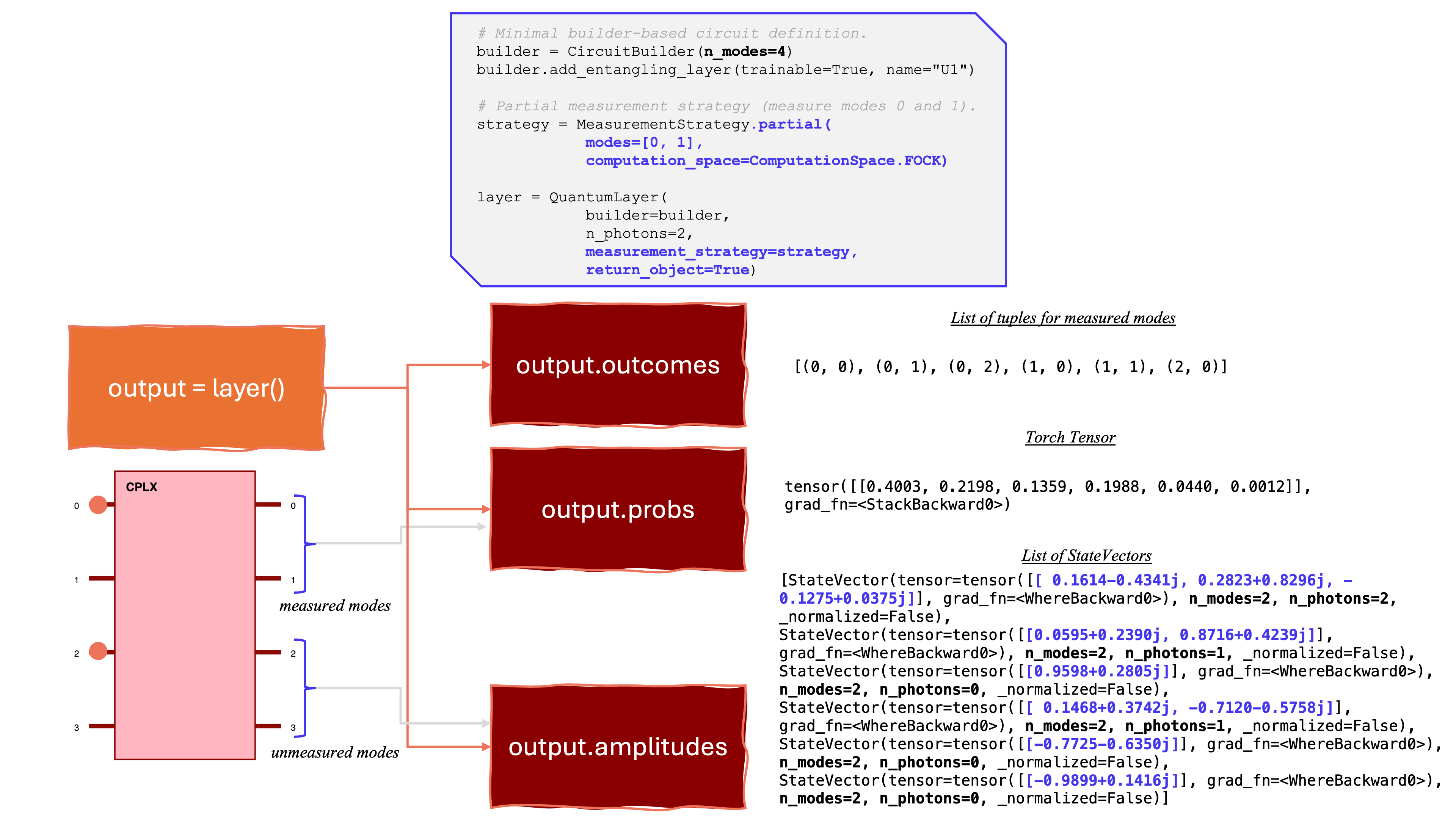
Below is an example based on a 4-mode circuit. We measure modes [0, 1]
out of 4 total modes with 2 photons in the Fock basis.
from merlin import CircuitBuilder, QuantumLayer
from merlin.core.computation_space import ComputationSpace
from merlin.measurement.strategies import MeasurementStrategy

# Minimal builder-based circuit definition.
builder = CircuitBuilder(n_modes=4)
builder.add_entangling_layer(trainable=True, name="U1")

# Partial measurement strategy (measure modes 0 and 1).
strategy = MeasurementStrategy.partial(
    modes=[0, 1],
    computation_space=ComputationSpace.FOCK,
)

layer = QuantumLayer(
    builder=builder,
    n_photons=2,
    measurement_strategy=strategy,
    return_object=True,
)

output = layer()

print(layer)
print(f" - Output type: {type(output)}")
print("--------- AMPLITUDES (unmeasured modes) ---------")
print(f" - Amplitudes = {output.amplitudes}")
print(f"\n - Amplitudes to tensor = {[amp.tensor for amp in output.amplitudes]}")
print(f"\n - Measured modes = {output.measured_modes}")
print(f"\n --------- PROBABILITIES (measured modes) ---------")
print(f"\n - Probabilities (tensor) = {output.probabilities}")
What you get (and what it means)
output is a PartialMeasurement object. The key fields are:
output.measured_modes: the indices you measured ((0, 1)here).output.outcomes: a list of tuples indicating the measured Fock outcomes for the measured modes.output.probabilities: a tensor with the probability of each measured-mode outcome. Each column corresponds to one measured Fock outcome.output.amplitudes: a list ofStateVectorobjects for the unmeasured modes only. The list is aligned withoutput.probabilities: each element is the conditional state given the corresponding measured outcome.
In other words, partial measurement returns a classical distribution for the measured modes and a quantum state for the unmeasured modes, with one conditional state per outcome.
Impact of computation space
The computation_space passed to MeasurementStrategy.partial(...) changes
the global admissible states, which directly changes partial-measurement results:
the possible measured outcomes (
output.outcomes),the branch probabilities (
output.probabilities),the remaining branch photon numbers and amplitude sizes (
output.amplitudes).
Example setup (same circuit, same measured modes [0, 1]):
builder = CircuitBuilder(n_modes=4)
builder.add_entangling_layer(trainable=True, name="U1")

strategy = MeasurementStrategy.partial(
    modes=[0, 1],  # measure modes 0 and 1
    computation_space=ComputationSpace.DUAL_RAIL,  # or UNBUNCHED
)
With ComputationSpace.DUAL_RAIL (4 modes, 2 photons), one photon must occupy
each rail pair. Measuring [0, 1] therefore gives only two valid outcomes:
Probability outcomes = [(0, 1), (1, 0)]
Probabilities shape = [batch, 2]
Amplitudes: each branch is StateVector(..., n_modes=2, n_photons=1)
With ComputationSpace.UNBUNCHED, photons are collision-free but not paired,
so more outcomes are valid on measured modes:
Probability outcomes = [(0, 0), (0, 1), (1, 0), (1, 1)]
Probabilities shape = [batch, 4]
Amplitudes: branches can have StateVector(..., n_photons=2), (..., n_photons=1), or (..., n_photons=0)
In this UNBUNCHED case, some amplitude entries can be exactly zero when they
correspond to invalid unbunched occupancy patterns in the underlying Fock
enumeration. For example, for a branch with n_modes=2 and n_photons=2,
the basis states (0,2) and (2,0) are invalid in UNBUNCHED and may
appear with null amplitudes, e.g.:
StateVector(tensor=tensor([[ 0.0000+0.0000j, -0.1111+0.9938j, 0.0000+0.0000j]], grad_fn=<WhereBackward0>), n_modes=2, n_photons=2, _normalized=False)
So, using the same measured subset, DUAL_RAIL yields fewer outcomes and
fixed remaining photon count, while UNBUNCHED yields more outcomes and
variable remaining photon count across branches (as many as UNBUNCHED space would
yield), while having some zero-amplitude entries.
About grouping in partial measurement
If you pass a grouping object to MeasurementStrategy.partial(...), it
only groups the probabilities, not the amplitudes. Concretely:
output.probabilities(oroutput.tensor) is grouped according to the grouping rule, so its second dimension becomes the grouping output size. This does not change the .outcomes themselves.output.amplitudesstays one conditional state per measured outcome. The amplitudes list is not grouped or merged.
This means grouping is a probability-only post-processing step. It changes the reported distribution of measured outcomes, while leaving the conditional state vectors for the unmeasured modes intact.