Hybrid Quantum-Classical Model Exploration
Overview
This notebook is inspired from https://opg.optica.org/viewmedia.cfm?r=1&rwjcode=opticaq&uri=opticaq-3-3-238&html=true and demonstrates a comparison between hybrid quantum-classical models and traditional linear models for image classification using the MNIST dataset. The implementation leverages the Merlin framework for quantum neural networks and PyTorch for classical neural networks.
Key Components
1. Model Architectures
QuantumReservoir Model
The main hybrid architecture combines:
A quantum layer processing PCA-reduced image features
A linear classifier operating on the concatenation of the original flattened image and quantum output
Linear Model
A simple linear classifier operating directly on flattened image features, serving as a baseline for comparison.
PCA Model
A linear classifier operating on PCA-reduced features to evaluate the information content of the dimensionality reduction.
2. Data Preparation
The MNIST dataset (Perceval Quest subset) is loaded using the custom
mnist_digitsmoduleImages are flattened and normalized
Principal Component Analysis (PCA) reduces feature dimensionality to a specified number of components
[1]:
import matplotlib.pyplot as plt
import perceval as pcvl  # just to display the circuit
import torch
import torch.nn as nn
from sklearn.decomposition import PCA

import merlin as ml
[2]:
# Simple Baseline Linear Model
class LinearModelBaseline(nn.Module):
    def __init__(self, image_size, num_classes=10):
        super().__init__()
        self.image_size = image_size

        # Classical part
        self.classifier = nn.Linear(image_size, num_classes)

    def forward(self, x):
        # Data is already flattened
        output = self.classifier(x)
        return output
[3]:
# LinearModel with PCA
class LinearModelPCA(nn.Module):
    def __init__(self, image_size, pca_components, num_classes=10):
        super().__init__()
        self.image_size = image_size
        self.pca_components = pca_components

        # Classical part
        self.classifier = nn.Linear(image_size + pca_components, num_classes)

    def forward(self, x, x_pca):
        # Data is already flattened, just concatenate
        combined_features = torch.cat((x, x_pca), dim=1)
        output = self.classifier(combined_features)
        return output
[4]:
# definition of QuantumReservoir class - quantum layer applying on pca, and linear classifier on input and pca
class QuantumReservoir(nn.Module):
    def __init__(self, image_size, pca_components, n_modes, n_photons, num_classes=10):
        super().__init__()
        self.image_size = image_size
        self.pca_components = pca_components
        self.n_modes = n_modes
        self.n_photons = n_photons

        # Quantum part (non-trainable reservoir)
        self.quantum_layer = self._create_quantum_reservoir(
            pca_components, n_modes, n_photons
        )

        # Classical part
        self.classifier = nn.Linear(
            image_size + self.quantum_layer.output_size, num_classes
        )

        print("\nQuantum Reservoir Created:")
        print(f"  Input size (PCA components): {pca_components}")
        print(f"  Quantum output size: {self.quantum_layer.output_size}")
        print(
            f"  Total features to classifier: {image_size + self.quantum_layer.output_size}"
        )

    def _create_quantum_reservoir(self, input_size, n_modes, n_photons):
        """Create quantum layer with Series circuit in reservoir mode."""


        # Create ansatz with automatic output size
        ansatz = ml.CircuitBuilder(n_modes=n_modes)
        num_param_assigned=0
        while num_param_assigned<input_size:
            ansatz.add_entangling_layer(trainable=False)
            if num_param_assigned+n_modes>input_size:
                ansatz.add_angle_encoding(modes=[i for i in range(input_size-num_param_assigned)])
            else:
                ansatz.add_angle_encoding()
            num_param_assigned+=n_modes
            ansatz.add_entangling_layer(trainable=False)


        # Create quantum layer
        quantum_layer = ml.QuantumLayer(
            input_size=input_size,
            builder=ansatz,
            n_photons=n_photons,
            measurement_strategy=ml.MeasurementStrategy.probs(computation_space=ml.ComputationSpace.FOCK),
            input_state=ml.generate_state(n_modes,n_photons,ml.StatePattern.PERIODIC),
        )

        return quantum_layer

    def forward(self, x, x_pca):
        # Process the PCA-reduced input through quantum layer
        quantum_output = self.quantum_layer(x_pca)

        # Concatenate original image features with quantum output
        combined_features = torch.cat((x, quantum_output), dim=1)

        # Final classification
        output = self.classifier(combined_features)
        return output
[5]:
from merlin.datasets import mnist_digits

train_features, train_labels, train_metadata = (
    mnist_digits.get_data_train_percevalquest()
)
test_features, test_labels, test_metadata = mnist_digits.get_data_test_percevalquest()

# Flatten the images from (N, 28, 28) to (N, 784)
train_features = train_features.reshape(train_features.shape[0], -1)
test_features = test_features.reshape(test_features.shape[0], -1)

# Convert data to PyTorch tensors
X_train = torch.FloatTensor(train_features)
y_train = torch.LongTensor(train_labels)
X_test = torch.FloatTensor(test_features)
y_test = torch.LongTensor(test_labels)

print(f"Dataset loaded: {len(X_train)} training samples, {len(X_test)} test samples")
Downloading train_9c076d75.csv...
Downloading val_db1aff78.csv...
Dataset loaded: 6000 training samples, 600 test samples
/var/folders/k_/9bm2xqh95599gcr_s25f45740000gn/T/ipykernel_46651/3726897863.py:14: UserWarning: The given NumPy array is not writable, and PyTorch does not support non-writable tensors. This means writing to this tensor will result in undefined behavior. You may want to copy the array to protect its data or make it writable before converting it to a tensor. This type of warning will be suppressed for the rest of this program. (Triggered internally at /Users/runner/work/pytorch/pytorch/pytorch/torch/csrc/utils/tensor_numpy.cpp:219.)
  y_train = torch.LongTensor(train_labels)
[6]:
n_components = 8
M = 9
N = 4
[7]:
# train PCA
pca = PCA(n_components=n_components)

# Note: Data is already flattened
X_train_flat = X_train
X_test_flat = X_test

pca.fit(X_train_flat)
X_train_pca = torch.FloatTensor(pca.transform(X_train_flat))
X_test_pca = torch.FloatTensor(pca.transform(X_test_flat))
print(X_train_pca)
tensor([[ 1.8300,  0.5722,  0.0553,  ..., -0.9327,  1.7091, -1.0757],
        [ 0.8860, -4.1798,  1.3963,  ...,  0.1214, -0.9332,  0.1375],
        [-0.2782,  1.7010,  0.4974,  ..., -0.4592, -1.0298,  1.7506],
        ...,
        [ 0.2924, -4.0464, -1.2219,  ..., -0.9094,  0.9778,  0.8639],
        [ 0.1567,  1.2983, -4.0294,  ..., -3.1339, -2.1578,  0.3930],
        [ 4.4576,  1.2257,  0.7489,  ..., -0.9504, -1.7015, -1.8587]])
[8]:
# define corresponding linear model for comparison
linear_model = LinearModelBaseline(X_train_flat.shape[1])
[9]:
# define model using pca featues
pca_model = LinearModelPCA(X_train_flat.shape[1], n_components)
[11]:
# define hybrid model
hybrid_model = QuantumReservoir(
    X_train_flat.shape[1], n_components, n_modes=M, n_photons=N
)
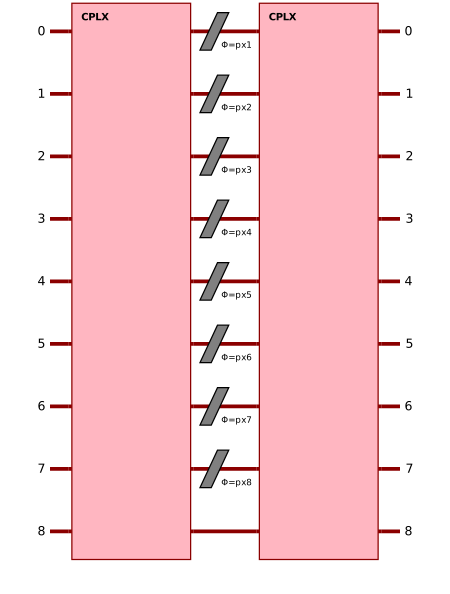
pcvl.pdisplay(hybrid_model.quantum_layer.circuit)
Quantum Reservoir Created:
  Input size (PCA components): 8
  Quantum output size: 495
  Total features to classifier: 1279
[11]:
[12]:
# Loss function and optimizer
criterion = nn.CrossEntropyLoss()
optimizer_linear = torch.optim.Adam(linear_model.parameters(), lr=0.001)
optimizer_pca = torch.optim.Adam(pca_model.parameters(), lr=0.001)
optimizer_hybrid = torch.optim.Adam(hybrid_model.parameters(), lr=0.001)

# Create DataLoader for batching
batch_size = 128
train_dataset = torch.utils.data.TensorDataset(X_train, X_train_pca, y_train)
train_loader = torch.utils.data.DataLoader(
    train_dataset, batch_size=batch_size, shuffle=True
)

# Training loop
num_epochs = 25

history = {
    "hybrid": {"loss": [], "accuracy": []},
    "pca": {"loss": [], "accuracy": []},
    "linear": {"loss": [], "accuracy": []},
    "epochs": [],
}

for epoch in range(num_epochs):
    running_loss_hybrid = 0.0
    running_loss_linear = 0.0
    running_loss_pca = 0.0

    hybrid_model.train()
    linear_model.train()
    pca_model.train()

    for _i, (images, pca_features, labels) in enumerate(train_loader):
        # Hybrid model - Forward and Backward pass
        outputs = hybrid_model(images, pca_features)
        loss = criterion(outputs, labels)
        optimizer_hybrid.zero_grad()
        loss.backward()
        optimizer_hybrid.step()
        running_loss_hybrid += loss.item()

        # Comparative linear model - Forward and Backward pass
        outputs = linear_model(images)
        loss = criterion(outputs, labels)
        optimizer_linear.zero_grad()
        loss.backward()
        optimizer_linear.step()
        running_loss_linear += loss.item()

        # Comparative pca model - Forward and Backward pass
        outputs = pca_model(images, pca_features)
        loss = criterion(outputs, labels)
        optimizer_pca.zero_grad()
        loss.backward()
        optimizer_pca.step()
        running_loss_pca += loss.item()

    avg_loss_hybrid = running_loss_hybrid / len(train_loader)
    avg_loss_linear = running_loss_linear / len(train_loader)
    avg_loss_pca = running_loss_pca / len(train_loader)

    history["hybrid"]["loss"].append(avg_loss_hybrid)
    history["linear"]["loss"].append(avg_loss_linear)
    history["pca"]["loss"].append(avg_loss_pca)

    history["epochs"].append(epoch + 1)

    hybrid_model.eval()
    linear_model.eval()
    pca_model.eval()
    with torch.no_grad():
        outputs = hybrid_model(X_test, X_test_pca)
        _, predicted = torch.max(outputs, 1)
        hybrid_accuracy = (predicted == y_test).sum().item() / y_test.size(0)

        outputs = linear_model(X_test)
        _, predicted = torch.max(outputs, 1)
        linear_accuracy = (predicted == y_test).sum().item() / y_test.size(0)

        outputs = pca_model(X_test, X_test_pca)
        _, predicted = torch.max(outputs, 1)
        pca_accuracy = (predicted == y_test).sum().item() / y_test.size(0)

    history["hybrid"]["accuracy"].append(hybrid_accuracy)
    history["linear"]["accuracy"].append(linear_accuracy)
    history["pca"]["accuracy"].append(pca_accuracy)

    print(
        f"Epoch [{epoch + 1}/{num_epochs}], LOSS -- Hybrid: {avg_loss_hybrid:.4f}, Linear: {avg_loss_linear:.4f}, PCA: {avg_loss_pca:.4f}"
        + f", ACCURACY -- Hybrid: {hybrid_accuracy:.4f}, Linear: {linear_accuracy:.4f}, PCA: {pca_accuracy:.4f}"
    )
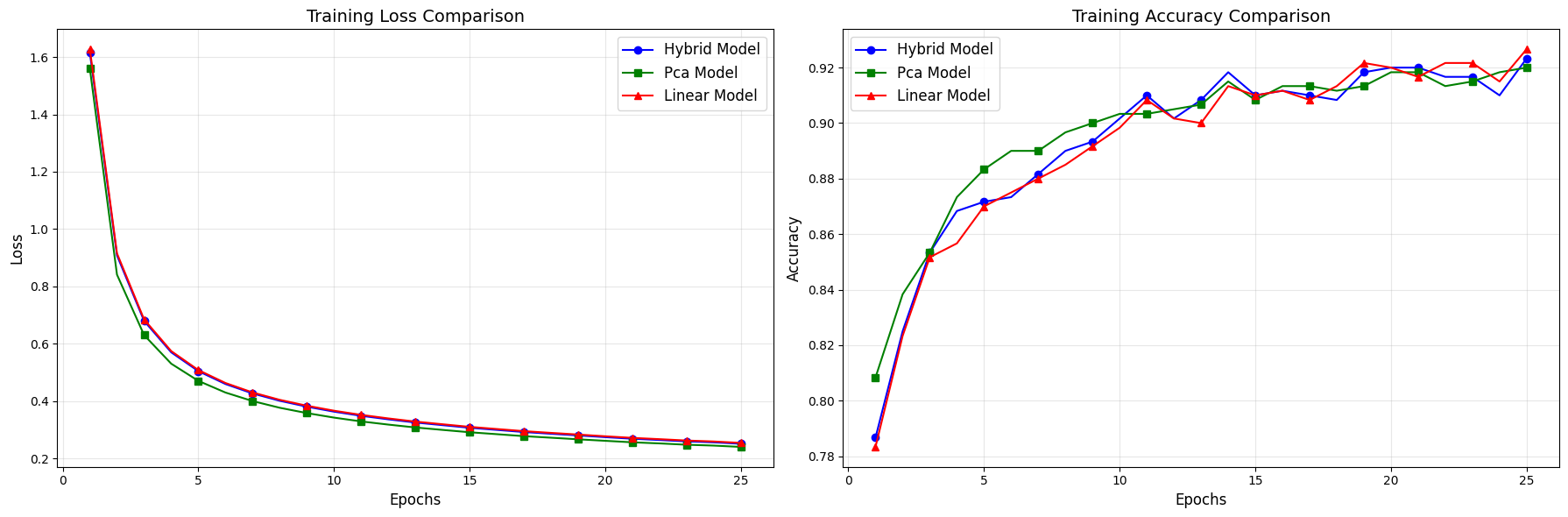
Epoch [1/25], LOSS -- Hybrid: 1.6153, Linear: 1.6277, PCA: 1.5599, ACCURACY -- Hybrid: 0.7867, Linear: 0.7833, PCA: 0.8083
Epoch [2/25], LOSS -- Hybrid: 0.9081, Linear: 0.9153, PCA: 0.8410, ACCURACY -- Hybrid: 0.8250, Linear: 0.8233, PCA: 0.8383
Epoch [3/25], LOSS -- Hybrid: 0.6794, Linear: 0.6847, PCA: 0.6301, ACCURACY -- Hybrid: 0.8533, Linear: 0.8517, PCA: 0.8533
Epoch [4/25], LOSS -- Hybrid: 0.5699, Linear: 0.5742, PCA: 0.5303, ACCURACY -- Hybrid: 0.8683, Linear: 0.8567, PCA: 0.8733
Epoch [5/25], LOSS -- Hybrid: 0.5043, Linear: 0.5081, PCA: 0.4704, ACCURACY -- Hybrid: 0.8717, Linear: 0.8700, PCA: 0.8833
Epoch [6/25], LOSS -- Hybrid: 0.4594, Linear: 0.4630, PCA: 0.4297, ACCURACY -- Hybrid: 0.8733, Linear: 0.8750, PCA: 0.8900
Epoch [7/25], LOSS -- Hybrid: 0.4265, Linear: 0.4299, PCA: 0.3999, ACCURACY -- Hybrid: 0.8817, Linear: 0.8800, PCA: 0.8900
Epoch [8/25], LOSS -- Hybrid: 0.4009, Linear: 0.4043, PCA: 0.3766, ACCURACY -- Hybrid: 0.8900, Linear: 0.8850, PCA: 0.8967
Epoch [9/25], LOSS -- Hybrid: 0.3804, Linear: 0.3837, PCA: 0.3580, ACCURACY -- Hybrid: 0.8933, Linear: 0.8917, PCA: 0.9000
Epoch [10/25], LOSS -- Hybrid: 0.3630, Linear: 0.3663, PCA: 0.3423, ACCURACY -- Hybrid: 0.9017, Linear: 0.8983, PCA: 0.9033
Epoch [11/25], LOSS -- Hybrid: 0.3486, Linear: 0.3518, PCA: 0.3290, ACCURACY -- Hybrid: 0.9100, Linear: 0.9083, PCA: 0.9033
Epoch [12/25], LOSS -- Hybrid: 0.3363, Linear: 0.3395, PCA: 0.3179, ACCURACY -- Hybrid: 0.9017, Linear: 0.9017, PCA: 0.9050
Epoch [13/25], LOSS -- Hybrid: 0.3252, Linear: 0.3284, PCA: 0.3079, ACCURACY -- Hybrid: 0.9083, Linear: 0.9000, PCA: 0.9067
Epoch [14/25], LOSS -- Hybrid: 0.3160, Linear: 0.3191, PCA: 0.2994, ACCURACY -- Hybrid: 0.9183, Linear: 0.9133, PCA: 0.9150
Epoch [15/25], LOSS -- Hybrid: 0.3069, Linear: 0.3100, PCA: 0.2912, ACCURACY -- Hybrid: 0.9100, Linear: 0.9100, PCA: 0.9083
Epoch [16/25], LOSS -- Hybrid: 0.2994, Linear: 0.3025, PCA: 0.2845, ACCURACY -- Hybrid: 0.9117, Linear: 0.9117, PCA: 0.9133
Epoch [17/25], LOSS -- Hybrid: 0.2920, Linear: 0.2951, PCA: 0.2776, ACCURACY -- Hybrid: 0.9100, Linear: 0.9083, PCA: 0.9133
Epoch [18/25], LOSS -- Hybrid: 0.2860, Linear: 0.2890, PCA: 0.2722, ACCURACY -- Hybrid: 0.9083, Linear: 0.9133, PCA: 0.9117
Epoch [19/25], LOSS -- Hybrid: 0.2801, Linear: 0.2832, PCA: 0.2666, ACCURACY -- Hybrid: 0.9183, Linear: 0.9217, PCA: 0.9133
Epoch [20/25], LOSS -- Hybrid: 0.2741, Linear: 0.2771, PCA: 0.2613, ACCURACY -- Hybrid: 0.9200, Linear: 0.9200, PCA: 0.9183
Epoch [21/25], LOSS -- Hybrid: 0.2686, Linear: 0.2716, PCA: 0.2561, ACCURACY -- Hybrid: 0.9200, Linear: 0.9167, PCA: 0.9183
Epoch [22/25], LOSS -- Hybrid: 0.2641, Linear: 0.2671, PCA: 0.2523, ACCURACY -- Hybrid: 0.9167, Linear: 0.9217, PCA: 0.9133
Epoch [23/25], LOSS -- Hybrid: 0.2593, Linear: 0.2623, PCA: 0.2476, ACCURACY -- Hybrid: 0.9167, Linear: 0.9217, PCA: 0.9150
Epoch [24/25], LOSS -- Hybrid: 0.2560, Linear: 0.2590, PCA: 0.2447, ACCURACY -- Hybrid: 0.9100, Linear: 0.9150, PCA: 0.9183
Epoch [25/25], LOSS -- Hybrid: 0.2510, Linear: 0.2540, PCA: 0.2400, ACCURACY -- Hybrid: 0.9233, Linear: 0.9267, PCA: 0.9200
[13]:
def plot_training_comparison(history):
    # Create a figure with two subplots side by side
    fig, (ax1, ax2) = plt.subplots(1, 2, figsize=(18, 6))

    # Define colors and styles for consistency
    model_styles = {
        "hybrid": {"color": "blue", "linestyle": "-", "marker": "o"},
        "pca": {"color": "green", "linestyle": "-", "marker": "s"},
        "linear": {"color": "red", "linestyle": "-", "marker": "^"},
    }

    # Plot loss curves
    for model_name, style in model_styles.items():
        if model_name in history:
            ax1.plot(
                history["epochs"],
                history[model_name]["loss"],
                color=style["color"],
                linestyle=style["linestyle"],
                marker=style["marker"],
                markevery=max(
                    1, len(history["epochs"]) // 10
                ),  # Show markers at 10 points
                label=f"{model_name.capitalize()} Model",
            )

    ax1.set_title("Training Loss Comparison", fontsize=14)
    ax1.set_xlabel("Epochs", fontsize=12)
    ax1.set_ylabel("Loss", fontsize=12)
    ax1.legend(fontsize=12)
    ax1.grid(True, alpha=0.3)

    # Plot accuracy curves
    for model_name, style in model_styles.items():
        if model_name in history:
            ax2.plot(
                history["epochs"],
                history[model_name]["accuracy"],
                color=style["color"],
                linestyle=style["linestyle"],
                marker=style["marker"],
                markevery=max(
                    1, len(history["epochs"]) // 10
                ),  # Show markers at 10 points
                label=f"{model_name.capitalize()} Model",
            )

    ax2.set_title("Training Accuracy Comparison", fontsize=14)
    ax2.set_xlabel("Epochs", fontsize=12)
    ax2.set_ylabel("Accuracy", fontsize=12)
    ax2.legend(fontsize=12)
    ax2.grid(True, alpha=0.3)

    plt.tight_layout()
    plt.show()


# Call the function to generate the plot
plot_training_comparison(history)