Hybrid Quantum Physics-Informed Neural Network for High-Speed Flows
Paper Information
Title: Hybrid Quantum Physics-informed Neural Network: Towards Efficient Learning of High-speed Flows
Authors: Fong Yew Leong, Wei-Bin Ewe, Si Bui Quang Tran, Zhongyuan Zhang, Jun Yong Khoo
Published: Computers & Fluids, Volume 301, 106782 (2025)
DOI: 10.1016/j.compfluid.2025.106782
Citations: 4(OpenAlex, as of 2026-08-28)
Paper URL: arXiv:2503.02202
Reproduction Status: ✅ Complete
Reproducer: Jérôme Ricciardi (jerome.ricciardi@quandela.com)
Project Repository
Abstract
This reproduction targets the hybrid quantum physics-informed neural network (HQPINN) benchmark proposed by Leong et al. The paper studies whether quantum branches can improve physics-informed learning on high-speed-flow problems by comparing classical-classical, hybrid quantum-classical, and quantum-quantum architectures.
The benchmark covers four problems:
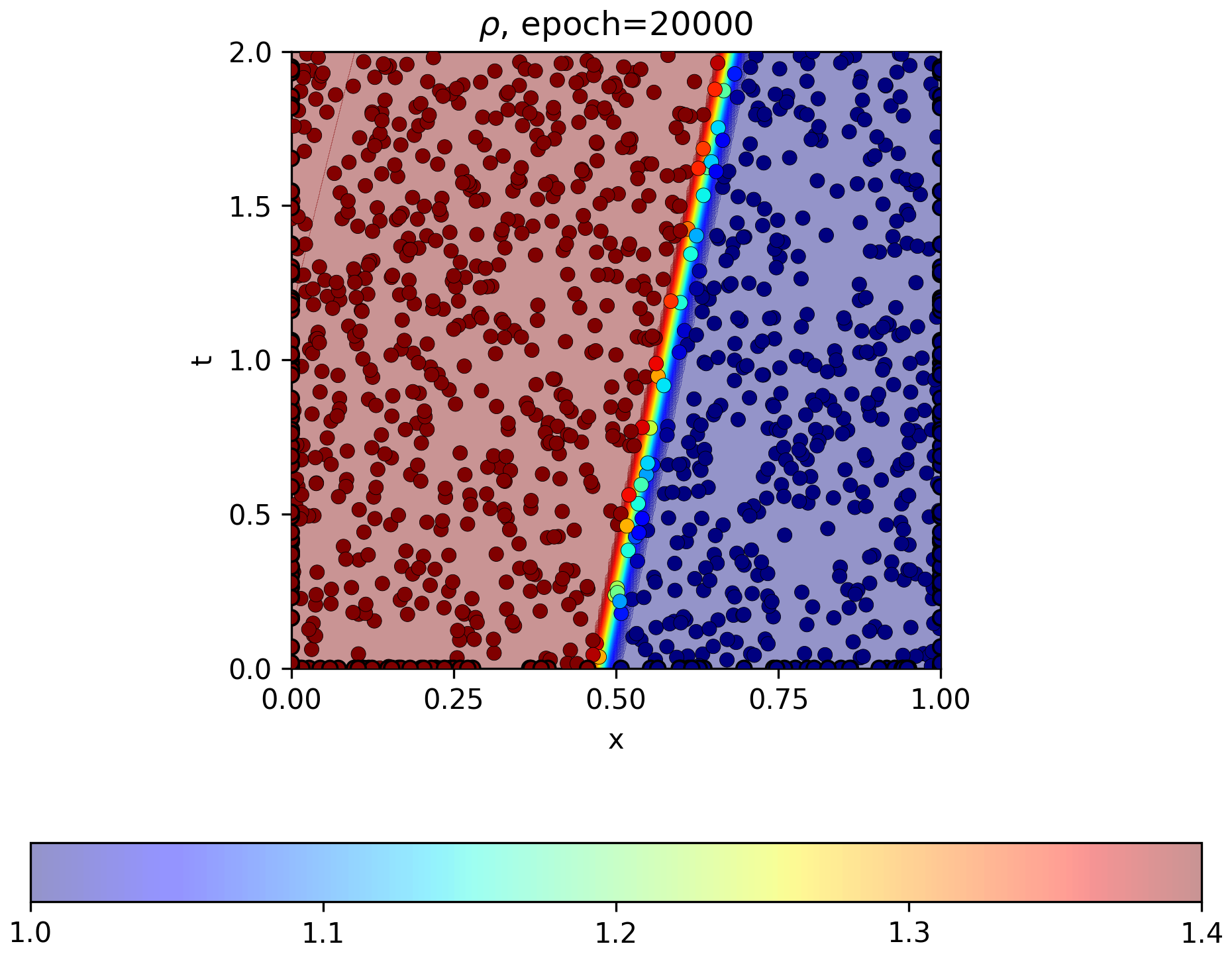
DHO: damped harmonic oscillator.SEE: smooth one-dimensional Euler equation.DEE: discontinuous one-dimensional Euler equation.TAF: steady two-dimensional transonic flow around a NACA0012 airfoil.
Each model is trained with a PINN objective combining data or boundary-condition terms with physics-residual terms computed through automatic differentiation.
Significance
The paper is relevant for near-term quantum machine learning because it tests quantum models on scientific machine-learning tasks where the target is not only data fitting but also equation consistency. It separates easier low-dimensional physics problems from harder high-speed-flow cases and compares quantum branches against direct classical PINN baselines.
For MerLin, this reproduction is a useful stress test for photonic
QuantumLayer models inside differentiable PDE-constrained training loops.
It exercises coordinate encoding, Fock-space probability readout, branch fusion,
and repeated automatic-differentiation residual evaluations.
MerLin Implementation
The reproduced implementation uses the repository-level implementation.py
runtime. The shared entrypoint dispatches into papers/HQPINN and then calls:
lib.runner.train_and_evaluate(cfg, run_dir)
The implementation supports the paper’s main architecture families and adds MerLin photonic variants:
Variant |
Meaning |
|---|---|
|
Classical-classical PINN with two classical branches. |
|
Hybrid model with one PennyLane quantum branch and one classical branch. |
|
Hybrid model with one MerLin photonic branch and one classical branch. |
|
DHO-only hybrid model using a manual Perceval/MerLin photonic branch. |
|
Quantum-quantum model with two PennyLane branches. |
|
Quantum-quantum model with two MerLin photonic branches. |
|
DHO-only quantum-quantum model with manual Perceval/MerLin branches. |
How QuantumLayer Fits This Reproduction
During local training, MerLin branches are differentiable PyTorch modules. The branch maps physical coordinates to angle features, evaluates a trainable photonic circuit, groups Fock-space probabilities with MerLin’s measurement strategy, and applies a small linear readout before fusing branch outputs.
Benchmark |
Feature map input |
|---|---|
|
Time |
|
|
|
|
|
|
Remote mode is inference-only. It loads a local checkpoint, rebuilds the MerLin
branch with a MerlinProcessor, and evaluates the saved model on the selected
backend:
python implementation.py --paper HQPINN --config configs/dho_hy_m_run.json --mode remote --backend sim:ascella
Remote mode does not train with remote gradients. Training configs run locally;
remote mode is only used after a matching checkpoint exists in models/.
Key Contributions Reproduced
Our reproduction focuses on the following contributions from the paper:
Benchmark implementation
Implemented the four benchmark families:
DHO,SEE,DEE, andTAF.Preserved the paper’s
cc,hy, andqqarchitecture split.Added config-driven execution through the repository shared runtime.
Photonic branch implementation
Added MerLin photonic branches for hybrid and quantum-quantum PINNs.
Added DHO-only manual Perceval/MerLin circuits for closer circuit-level control.
Kept PennyLane variants for comparison where local runtime is practical.
Experimental Results
The committed results are small classical-classical baseline runs used as a documentation snapshot. They are not the full paper matrix.
Benchmark |
Config |
Main metric |
|---|---|---|
|
|
Relative L2 error |
|
|
Density error |
|
|
Density error |
Current qualitative status:
DHO,SEE, andDEEhave runnable train and inference paths.TAFis implemented as a geometry-aware PINN baseline because the original internal CFD target fields are unavailable.The default config is a lightweight DHO inference smoke check.
PennyLane variants outside
DHOare expensive on CPU and are not part of the standard batch launcher.
Comparison With the Paper
The implementation follows the paper’s benchmark split and architecture naming.
The main mismatch is TAF: without supervised CFD targets for internal
points, this reproduction cannot fully match the paper’s transonic-airfoil
results or Figure 7 flow structure.
Other known deviations:
Full-batch training from the paper is not reproduced for all cases; minibatch training is used where needed for local runtime.
PennyLane runs outside
DHOare limited by CPU latency.The paper describes hybrid output fusion as a fixed branch combination, while the reproduction uses explicit local branch fusion code.
The MerLin interferometer is a photonic formulation of the branch, not an exact circuit-for-circuit reproduction of the original PennyLane ansatz.
Interactive Exploration
The paper folder includes a notebook for interactive DHO exploration and helper utilities.
Extensions and Future Work
Current next steps are:
Test additional MerLin interferometer shapes and photonic encodings.
Build more manual Perceval circuits that mimic the original PQC structure, following the DHO manual-circuit path.
Contact the paper authors for the missing TAF internal CFD target fields.
Clarify original quantum implementation details that are underspecified in the paper.
Complete the full result matrix for MerLin and PennyLane variants where runtime permits.
Code Access and Documentation
Reproduction Repository: merlinquantum/reproduced_papers (HQPINN)
For command-line usage, config naming, output layout, and limitations, see the project README: HQPINN README.
Citation
@article{leong2025hybrid,
     title={Hybrid quantum physics-informed neural network: Towards efficient learning of high-speed flows},
     author={Leong, Fong Yew and Ewe, Wei-Bin and Tran, Si Bui Quang and Zhang, Zhongyuan and Khoo, Jun Yong},
     journal={Computers \& Fluids},
     pages={106782},
     year={2025},
     publisher={Elsevier}
     }